


Question: Consider a two-period model with an incumbent and a potential entrant. The incumbent firm is a protected monopoly in the first period (say due to
Consider a two-period model with an incumbent and

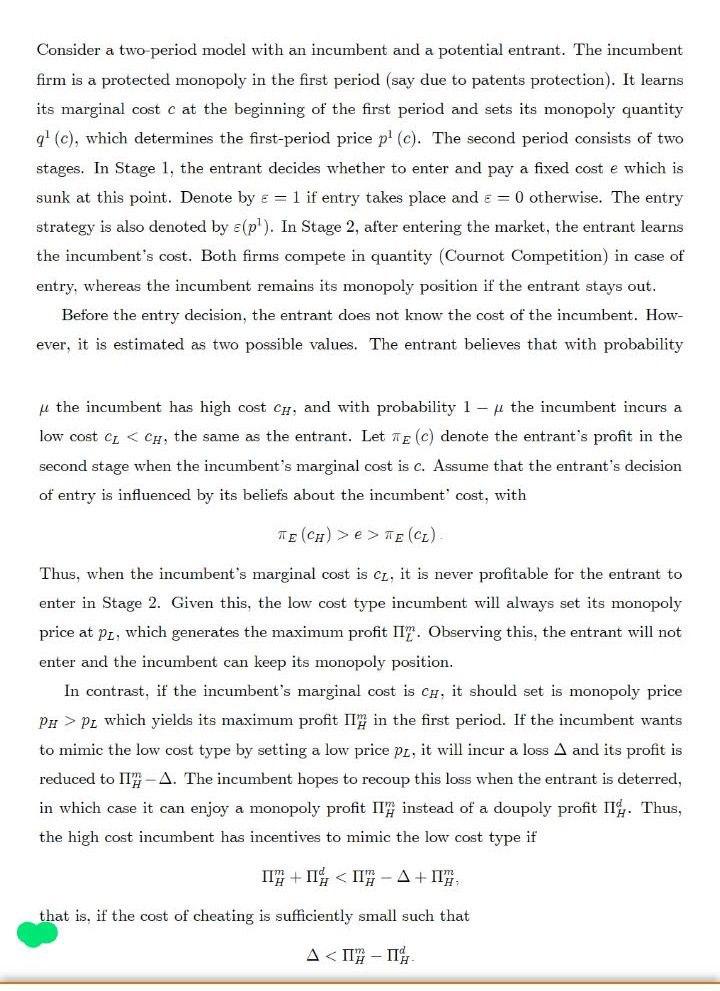
Consider a two-period model with an incumbent and a potential entrant. The incumbent firm is a protected monopoly in the first period (say due to patents protection). It learns its marginal cost c at the beginning of the first period and sets its monopoly quantity q' (c), which determines the first-period price pl (c). The second period consists of two stages. In Stage 1, the entrant decides whether to enter and pay a fixed cost e which is sunk at this point. Denote by e = 1 if entry takes place and = = 0 otherwise. The entry strategy is also denoted by e(pl). In Stage 2, after entering the market, the entrant learns the incumbent's cost. Both firms compete in quantity (Cournot Competition) in case of entry, whereas the incumbent remains its monopoly position if the entrant stays out. Before the entry decision, the entrant does not know the cost of the incumbent. How- ever, it is estimated as two possible values. The entrant believes that with probability u the incumbent has high cost Ch, and with probability 1 - p the incumbent incurs a low cost ez e>TE (CL) Thus, when the incumbent's marginal cost is cr, it is never profitable for the entrant to enter in Stage 2. Given this, the low cost type incumbent will always set its monopoly price at PL, which generates the maximum profit II. Observing this, the entrant will not enter and the incumbent can keep its monopoly position. In contrast, if the incumbent's marginal cost is ch, it should set is monopoly price PH > P which yields its maximum profit II in the first period. If the incumbent wants to mimic the low cost type by setting a low price pl, it will incur a loss A and its profit is reduced to IT-A. The incumbent hopes to recoup this loss when the entrant is deterred, in which case it can enjoy a monopoly profit IT' instead of a doupoly profit Ily. Thus, the high cost incumbent has incentives to mimic the low cost type if II + II

Step by Step Solution

There are 3 Steps involved in it

1 Expert Approved Answer
Step: 1 Unlock blur-text-image

Question Has Been Solved by an Expert!

Get step-by-step solutions from verified subject matter experts

Step: 2 Unlock
Step: 3 Unlock

Students Have Also Explored These Related General Management Questions!