



Question: Consider a typical consumer whose preferences can be represented by a Constant Elasticity of Substitution (CES) utility function U(x1,x2)=(x1+x2)1/ where x1 represents the amount of
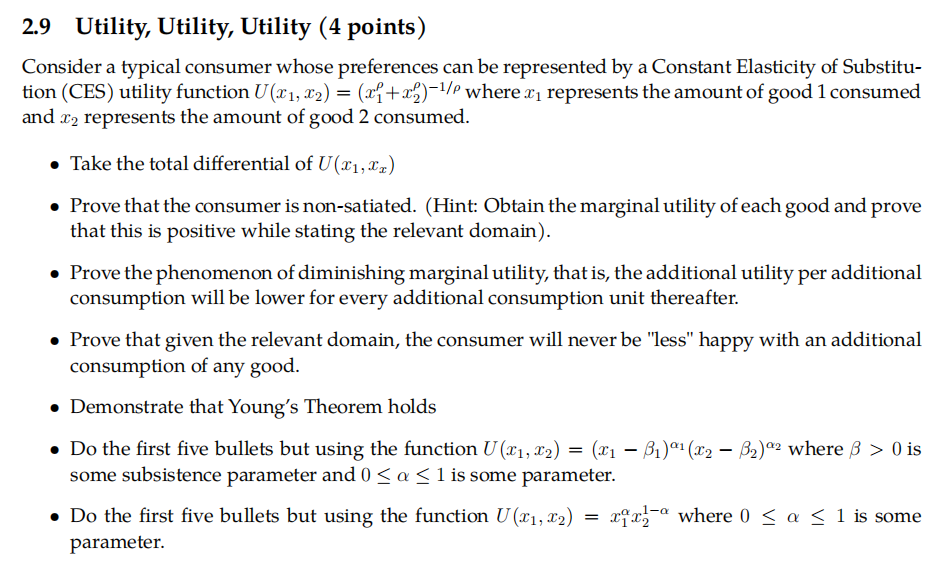
Consider a typical consumer whose preferences can be represented by a Constant Elasticity of Substitution (CES) utility function U(x1,x2)=(x1+x2)1/ where x1 represents the amount of good 1 consumed and x2 represents the amount of good 2 consumed. - Take the total differential of U(x1,xx) - Prove that the consumer is non-satiated. (Hint: Obtain the marginal utility of each good and prove that this is positive while stating the relevant domain). - Prove the phenomenon of diminishing marginal utility, that is, the additional utility per additional consumption will be lower for every additional consumption unit thereafter. - Prove that given the relevant domain, the consumer will never be "less" happy with an additional consumption of any good. - Demonstrate that Young's Theorem holds - Do the first five bullets but using the function U(x1,x2)=(x11)1(x22)2 where >0 is some subsistence parameter and 01 is some parameter. - Do the first five bullets but using the function U(x1,x2)=x1x21 where 01 is some parameter
Step by Step Solution
There are 3 Steps involved in it

Get step-by-step solutions from verified subject matter experts