







Question: . Consider a utility maximizing family, whose utility can be defined as U =f(wW + wH) where W 3. Consider a utility maximizing family, whose
. Consider a utility maximizing family, whose utility can be defined as U =f(wW + wH) where W\
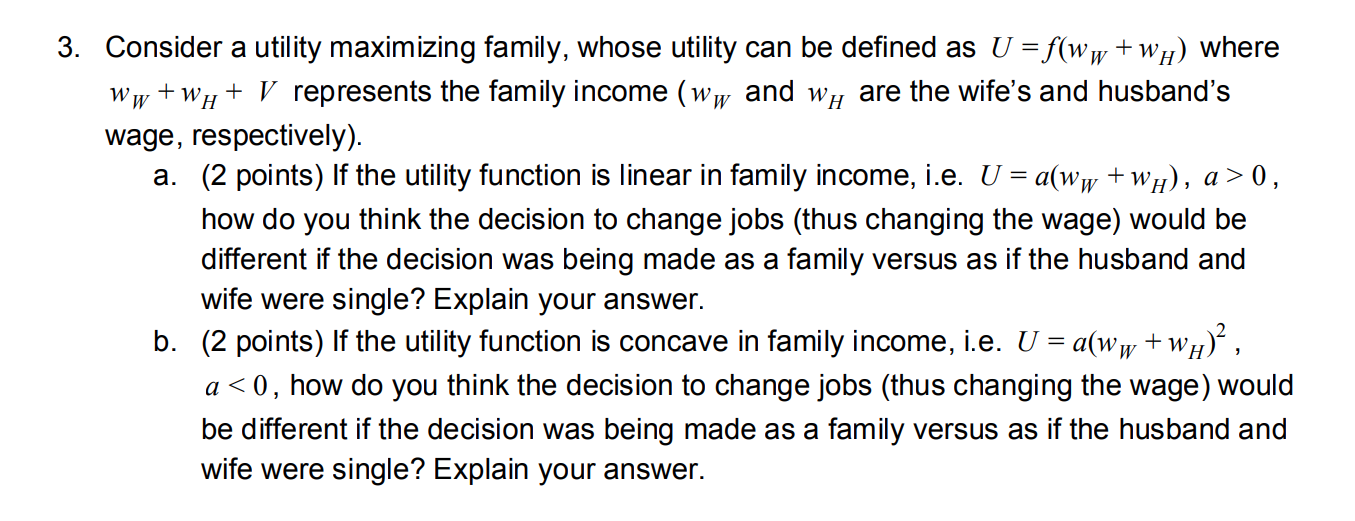
3. Consider a utility maximizing family, whose utility can be defined as U + WH) where ww + WH+ V represents the family income (ww and are the wife's and husband's wage, respectively). a. b. (2 points) If the utility function is linear in family income, i.e. U = a(ww + WII), a > 0, how do you think the decision to change jobs (thus changing the wage) would be different if the decision was being made as a family versus as if the husband and wife were single? Explain your answer. (2 points) If the utility function is concave in family income, i.e. U = a(ww + WH)2 , a < 0, how do you think the decision to change jobs (thus changing the wage) would be different if the decision was being made as a family versus as if the husband and wife were single? Explain your answer.
Step by Step Solution
There are 3 Steps involved in it

Get step-by-step solutions from verified subject matter experts
 Study Help