







Question: (*) Consider a wealth-constrained firm and a lender operating in a two- period model (ty and t2) with no discounting. At date 1, the
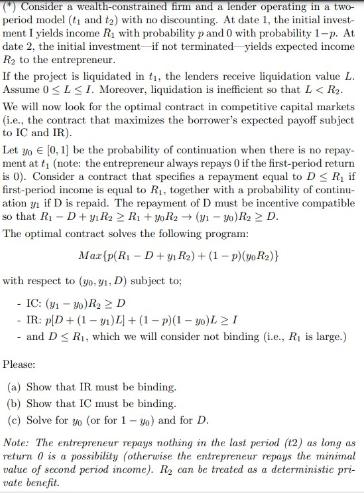
(*) Consider a wealth-constrained firm and a lender operating in a two- period model (ty and t2) with no discounting. At date 1, the initial invest- ment 1 yields income R with probability p and 0 with probability 1-p. At date 2, the initial investment if not terminated yields expected income R to the entrepreneur. If the project is liquidated in t, the lenders receive liquidation value L. Assume 0L I. Moreover, liquidation is inefficient so that L < R. We will now look for the optimal contract in competitive capital markets. (i.e., the contract that maximizes the borrower's expected payoff subject to IC and IR). Let yo [0, 1] be the probability of continuation when there is no repay- ment at t (note: the entrepreneur always repays 0 if the first-period return is 0). Consider a contract that specifies a repayment equal to D R if first-period income is equal to R, together with a probability of continu- ation y if D is repaid. The repayment of D must be incentive compatible so that R - D + yR2 R+yoR2 (30) R2 D. The optimal contract solves the following program: Max(p(RD+91 R)+(1-p)(yo R)} with respect to (30-31, D) subject to; - IC: (91-30) R2 D - IR: p[D+ (1 -y) L + (1 -p)(1-yo)L 21 - and D < R, which we will consider not binding (i.e., R, is large.) Please: (a) Show that IR must be binding. (b) Show that IC must be binding. (c) Solve for yo (or for 1-0) and for D. Note: The entrepreneur repays nothing in the last period (12) as long as return 0 is a possibility (otherwise the entrepreneur repays the minimal value of second period income). R can be treated as a deterministic pri- vate benefit.
Step by Step Solution
There are 3 Steps involved in it
a To show that IR must be binding lets consider the two cases Case 1 IR is not binding ie the inequa... View full answer

Get step-by-step solutions from verified subject matter experts
 Study Help