







Question: Consider a worker-owner model with two goods and two consumers. The worker (consumer 1) has an initial endowment of 10 units of labor time and
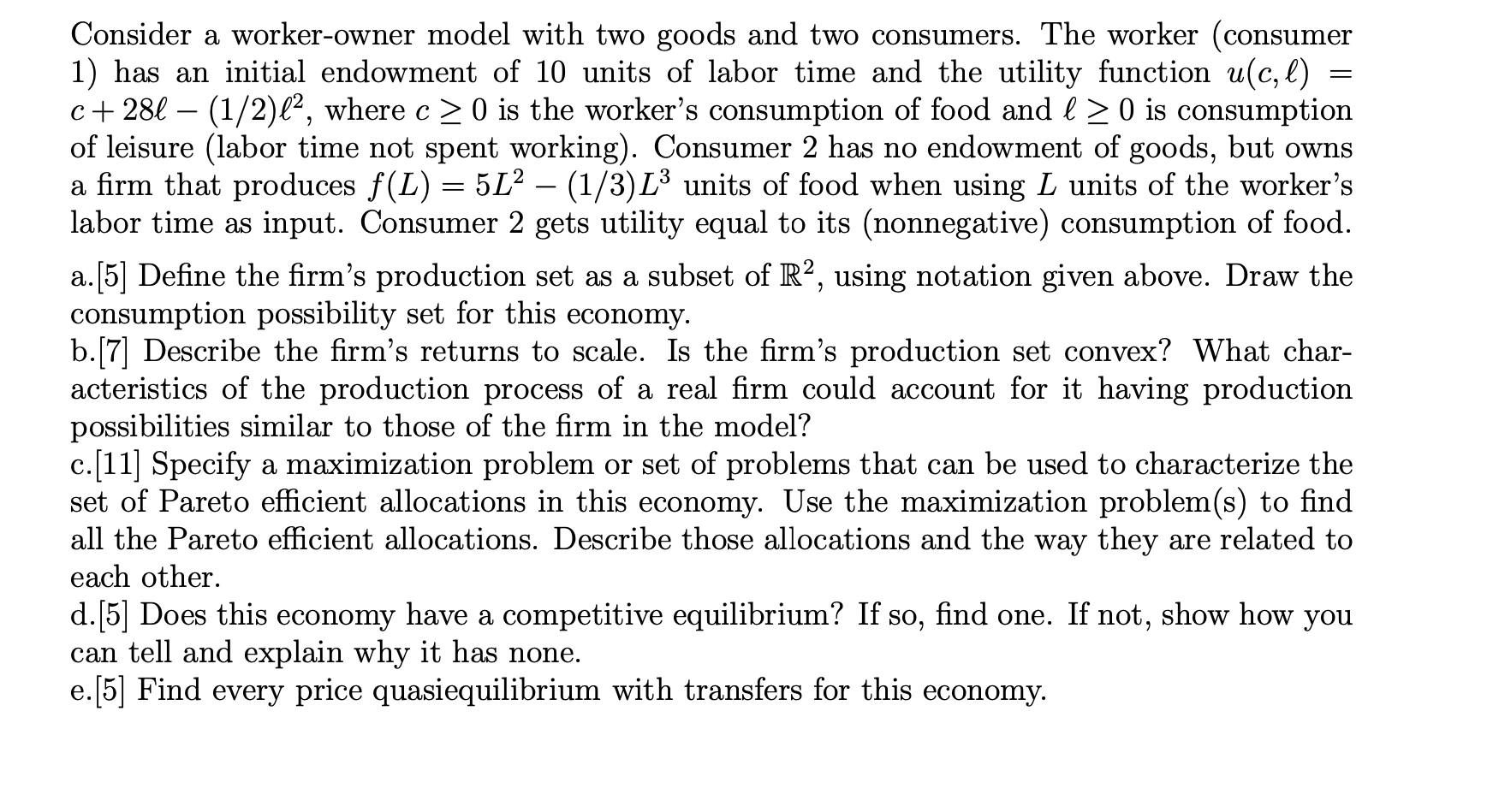
Consider a worker-owner model with two goods and two consumers. The worker (consumer 1) has an initial endowment of 10 units of labor time and the utility function uc, l). c+ 281 (1/2)l2, where c> 0 is the worker's consumption of food and l > 0 is consumption of leisure (labor time not spent working). Consumer 2 has no endowment of goods, but owns a firm that produces f(L) = 5L (1/3)L3 units of food when using L units of the worker's labor time as input. Consumer 2 gets utility equal to its (nonnegative) consumption of food. a. [5] Define the firm's production set as a subset of R2, using notation given above. Draw the consumption possibility set for this economy. b.[7] Describe the firm's returns to scale. Is the firm's production set convex? What char- acteristics of the production process of a real firm could account for it having production possibilities similar to those of the firm in the model? c.[11] Specify a maximization problem or set of problems that can be used to characterize the set of Pareto efficient allocations in this economy. Use the maximization problem(s) to find all the Pareto efficient allocations. Describe those allocations and the way they are related to each other. d.[5] Does this economy have a competitive equilibrium? If so, find one. If not, show how you can tell and explain why it has none. e.[5] Find every price quasiequilibrium with transfers for this economy. Consider a worker-owner model with two goods and two consumers. The worker (consumer 1) has an initial endowment of 10 units of labor time and the utility function uc, l). c+ 281 (1/2)l2, where c> 0 is the worker's consumption of food and l > 0 is consumption of leisure (labor time not spent working). Consumer 2 has no endowment of goods, but owns a firm that produces f(L) = 5L (1/3)L3 units of food when using L units of the worker's labor time as input. Consumer 2 gets utility equal to its (nonnegative) consumption of food. a. [5] Define the firm's production set as a subset of R2, using notation given above. Draw the consumption possibility set for this economy. b.[7] Describe the firm's returns to scale. Is the firm's production set convex? What char- acteristics of the production process of a real firm could account for it having production possibilities similar to those of the firm in the model? c.[11] Specify a maximization problem or set of problems that can be used to characterize the set of Pareto efficient allocations in this economy. Use the maximization problem(s) to find all the Pareto efficient allocations. Describe those allocations and the way they are related to each other. d.[5] Does this economy have a competitive equilibrium? If so, find one. If not, show how you can tell and explain why it has none. e.[5] Find every price quasiequilibrium with transfers for this economy
Step by Step Solution
There are 3 Steps involved in it

Get step-by-step solutions from verified subject matter experts
 Study Help