







Question: Consider a world with two countries and three goods. Both countries can use linear labor-only technologies to produce these goods. The labor productivities in the
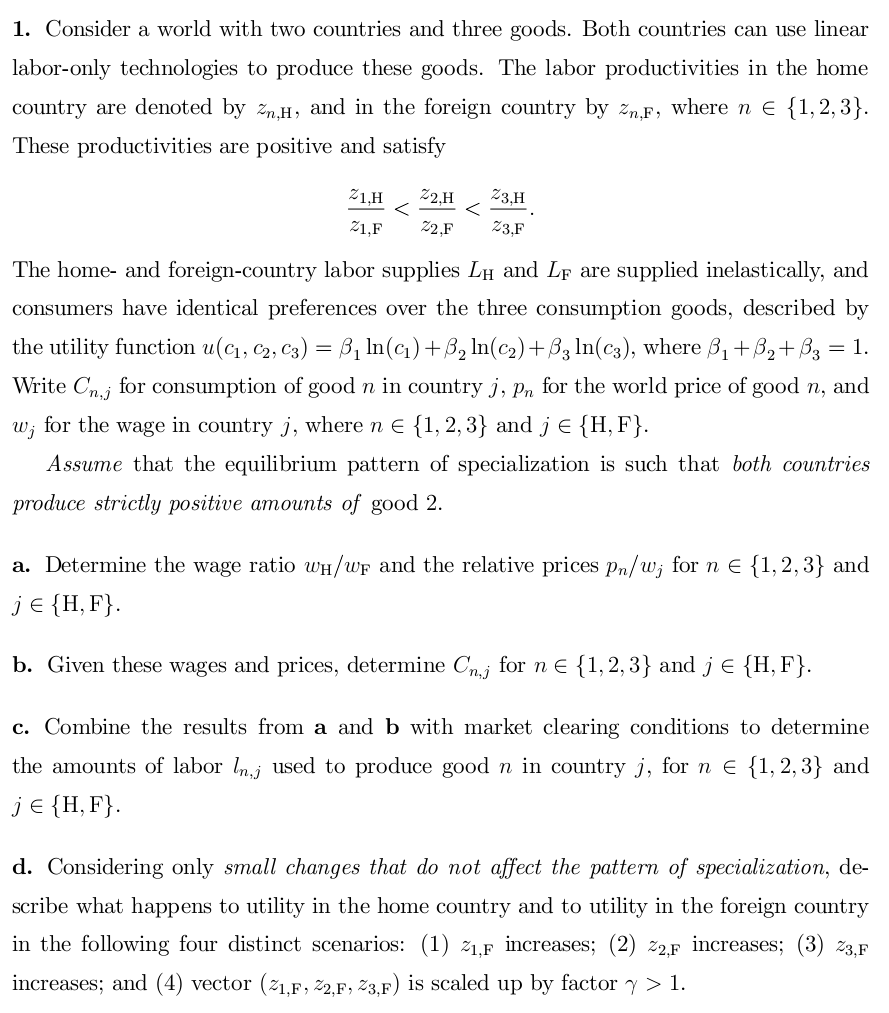
Consider a world with two countries and three goods. Both countries can use linear labor-only technologies to produce these goods. The labor productivities in the home country are denoted by Zn,H, and in the foreign country by Zn,F, where n falls in {1, 2, 3}. The home- and foreign-country labor supplies Lh and Lf are supplied inelastically, and consumers have identical preferences over the three consumption goods, described by the utility function u(C1, C2, C3) = B1In(c1)+B2 In(c2)+B3 In(c3), where B1+B2+B3 = 1. Write Cn.j for consumption of good n in country j, Pn for the world price of good n, and w; for the wage in country j, where n falls in {1, 2, 3} and j falls in {H, F}. Assume that the equilibrium pattern of specialization is such that both countries produce strictly positive amounts of good 2.
1. Consider a world with two countries and three goods. Both countries can use linear labor-only technologies to produce these goods. The labor productivities in the home country are denoted by Zn,H, and in the foreign country by Zn,F, where ne {1, 2,3}. These productivities are positive and satisfy 21.H 22.H 23.1 1. 1. Consider a world with two countries and three goods. Both countries can use linear labor-only technologies to produce these goods. The labor productivities in the home country are denoted by Zn,H, and in the foreign country by Zn,F, where ne {1, 2,3}. These productivities are positive and satisfy 21.H 22.H 23.1 1
Step by Step Solution
There are 3 Steps involved in it

Get step-by-step solutions from verified subject matter experts
 Study Help