Question: Consider a zero- sum game with players A and B. Player A has strategies A1 and A2 , while player B has strategies B and
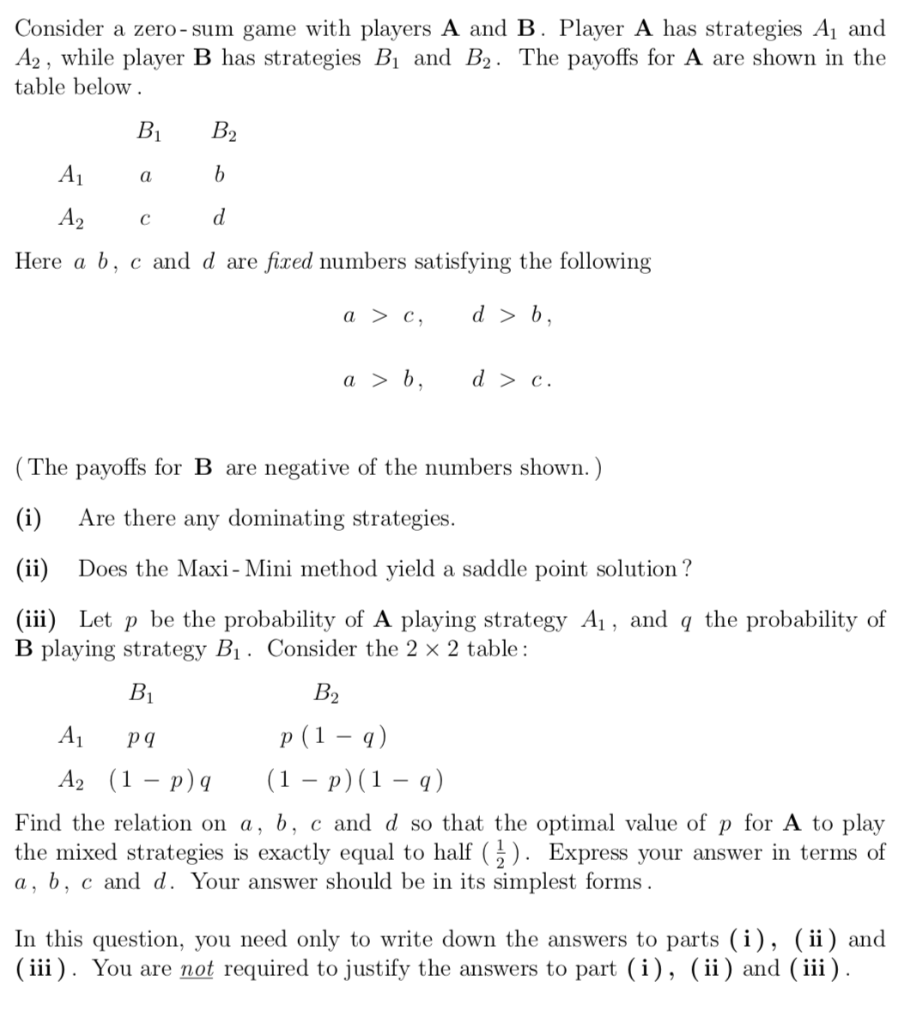
Consider a zero- sum game with players A and B. Player A has strategies A1 and A2 , while player B has strategies B and B2. The payoffs for A are shown in the table below. Bi B2 , - A c d Here a b, c and d are fixed numbers satisfying the following a > c, d > b, a >b, d > c. (The payoffs for B are negative of the numbers shown.) (i) Are there any dominating strategies. (ii) Does the Maxi - Mini method yield a saddle point solution ? (iii) Let p be the probability of A playing strategy Al, and q the probability of B playing strategy Bi. Consider the 2 x 2 table: B B2 , pq p(1 - 0) A2 (1 p) (1 p)(1 9) Find the relation on a, b, c and d so that the optimal value of p for A to play the mixed strategies is exactly equal to half (). Express your answer in terms of a, b, c and d. Your answer should be in its simplest forms. In this question, you need only to write down the answers to parts (i), (ii) and (iii). You are not required to justify the answers to part (i), (ii) and (iii). Consider a zero- sum game with players A and B. Player A has strategies A1 and A2 , while player B has strategies B and B2. The payoffs for A are shown in the table below. Bi B2 , - A c d Here a b, c and d are fixed numbers satisfying the following a > c, d > b, a >b, d > c. (The payoffs for B are negative of the numbers shown.) (i) Are there any dominating strategies. (ii) Does the Maxi - Mini method yield a saddle point solution ? (iii) Let p be the probability of A playing strategy Al, and q the probability of B playing strategy Bi. Consider the 2 x 2 table: B B2 , pq p(1 - 0) A2 (1 p) (1 p)(1 9) Find the relation on a, b, c and d so that the optimal value of p for A to play the mixed strategies is exactly equal to half (). Express your answer in terms of a, b, c and d. Your answer should be in its simplest forms. In this question, you need only to write down the answers to parts (i), (ii) and (iii). You are not required to justify the answers to part (i), (ii) and (iii)









 Study Help