







Question: Consider again the repeated game in Exercise 1, where the stage game is the prisoner's dilemma game shown below and the repeated strategies o, 7,
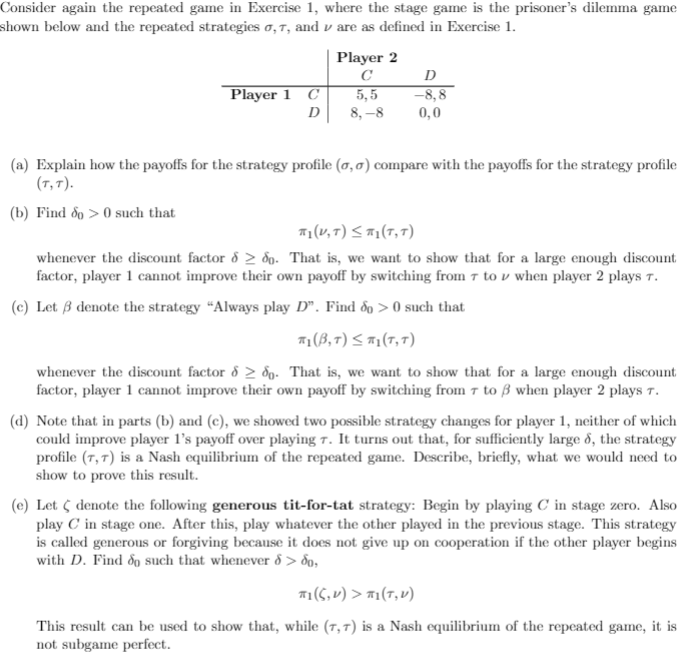
Consider again the repeated game in Exercise 1, where the stage game is the prisoner's dilemma game shown below and the repeated strategies o, 7, and v are as defined in Exercise 1. Player 2 D Player 1 C 5,5 -8,8 D 8, -8 0,0 (a) Explain how the payoffs for the strategy profile (o, o) compare with the payoffs for the strategy profile ( T, T ) . (b) Find do > 0 such that (V, T ) STI(T, T ) whenever the discount factor 6 2 60. That is, we want to show that for a large enough discount factor, player 1 cannot improve their own payoff by switching from + to v when player 2 plays T. (c) Let # denote the strategy "Always play D". Find do > 0 such that #1( B, T) STI(T, T ) whenever the discount factor o 2 6. That is, we want to show that for a large enough discount factor, player 1 cannot improve their own payoff by switching from 7 to S when player 2 plays T. (d) Note that in parts (b) and (c), we showed two possible strategy changes for player 1, neither of which could improve player 's payoff over playing 7. It turns out that, for sufficiently large o, the strategy profile (7, T) is a Nash equilibrium of the repeated game. Describe, briefly, what we would need to show to prove this result. (e) Let do, *1 (S, V) > #1(T, V) This result can be used to show that, while (7, 7) is a Nash equilibrium of the repeated game, it is not subgame perfect
Step by Step Solution
There are 3 Steps involved in it

Get step-by-step solutions from verified subject matter experts
 Study Help