







Question: Consider again the Solow-Swan model. Assume the production function is the CES function: Y(t) = (?[K(t)] ? + (1-? )[A(t)L(t)] ? ) 1/? , ?
Consider again the Solow-Swan model. Assume the production function is the CES function: Y(t) = (?[K(t)]?+ (1-? )[A(t)L(t)]?)1/? , ?
(a) Show that this production function exhibits constant returns to scale.
(b) Derive the expression for the production function with output and capital measured in efficiency units of labor. (c) Derive the first-order conditions for the profit-maximization problem of firms.
(d) Define the shares of labor and capital in output and show that the shares add up to one.
(e) Show that, at any point in time, the ratio of the share of labor to the share of capital is a monotone function of the capital-output ratio.
(f) Suppose the ratio of the real wage to the rental price of capital increases by 1% (along the transition path with technological progress). Calculate the percentage change in the capital-labor ratio and comment on how your calculation reflects a constant elasticity of substitution between labor and capital.
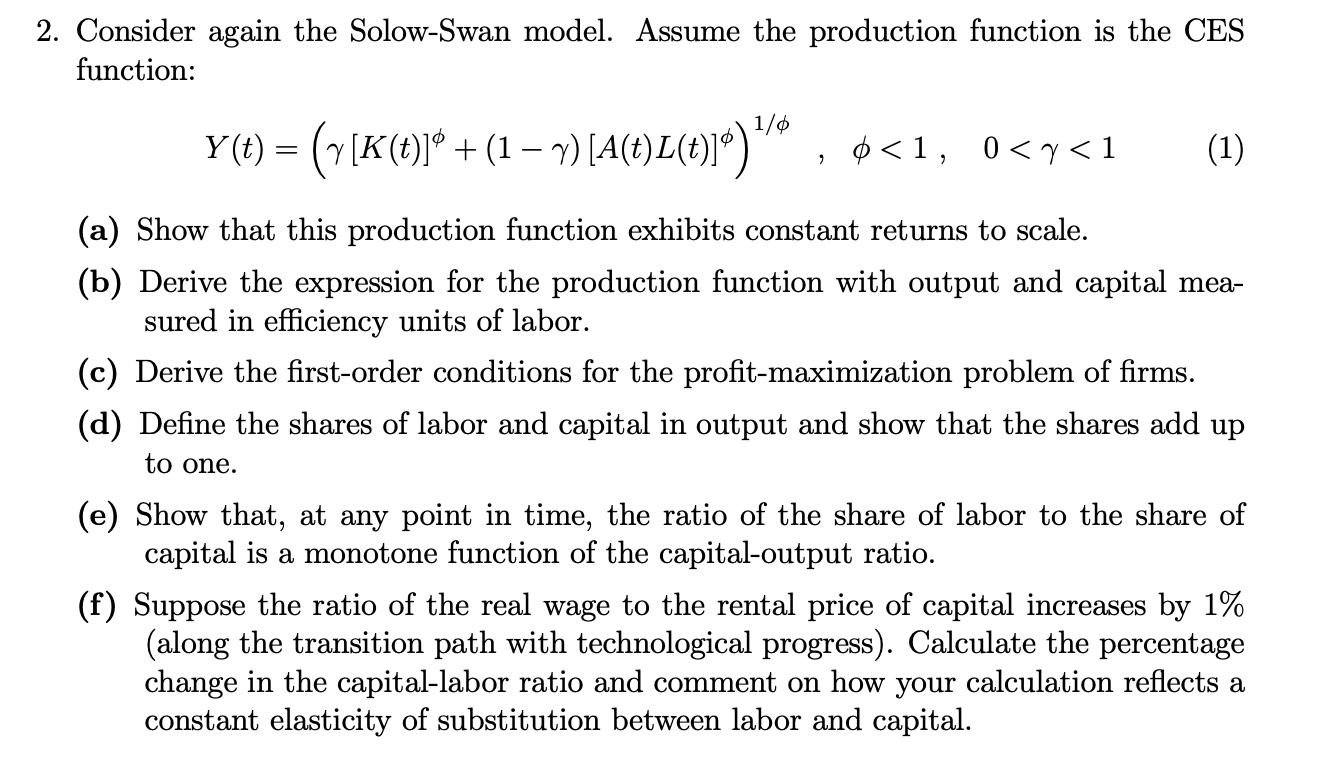
2. Consider again the SolowSwan model. Assume the production function is the CES function: m):(7[K(t)1+(1w)[A(t)L(t)1)W .
Step by Step Solution
There are 3 Steps involved in it

Get step-by-step solutions from verified subject matter experts
 Study Help