







Question: Consider an aggregate planning problem that is modeled using the fol- lowing decision variables. The decision variables are provided below W;= #ofworkersinyeartfort=0,1,...,T H,= # of
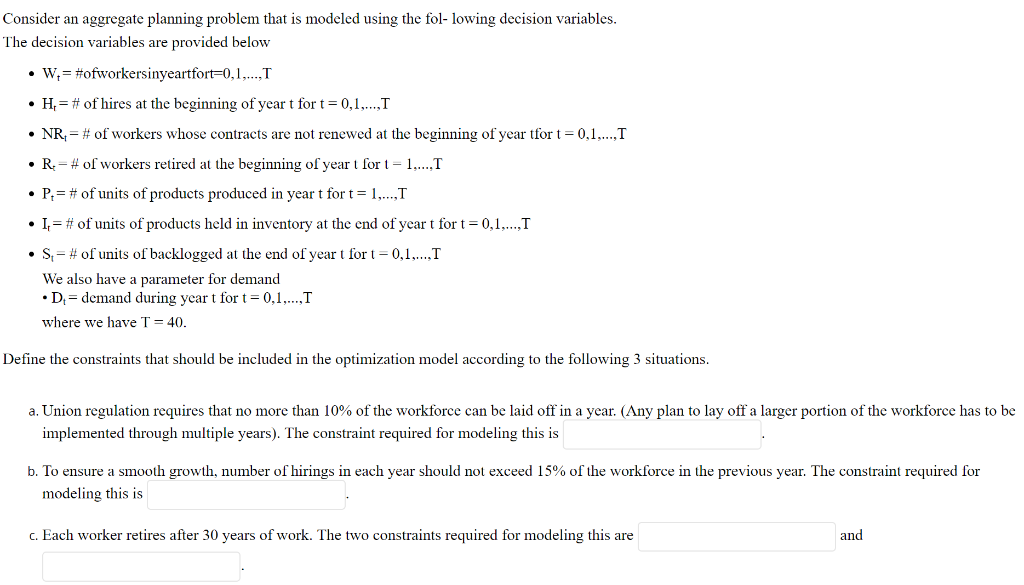
Consider an aggregate planning problem that is modeled using the fol- lowing decision variables. The decision variables are provided below W;= #ofworkersinyeartfort=0,1,...,T H,= # of hires at the beginning of year t for t=0,1,...,I NR= # of workers whose contracts are not renewed at the beginning of year tfort = 0,1,...,T R=# of workers retired at the beginning of year t for 1 - 1.....T P= # of units of products produced in year t for t = 1,...,T 1,=# of units of products held in inventory at the end of year t for t = 0,1,...,I S,= # of units of backlogged at the end of year t for t=0,1,...,T We also have a parameter for demand D = demand during year t for t=0,1,...,T where we have T = 40. Define the constraints that should be included in the optimization model according to the following 3 situations. a. Union regulation requires that no more than 10% of the workforce can be laid off in a year. (Any plan to lay off a larger portion of the workforce has to be implemented through multiple years). The constraint required for modeling this is b. To ensure a smooth growth, number of hirings in each year should not exceed 15% of the workforce in the previous year. The constraint required for modeling this is c. Each worker retires after 30 years of work. The two constraints required for modeling this are and Consider an aggregate planning problem that is modeled using the fol- lowing decision variables. The decision variables are provided below W;= #ofworkersinyeartfort=0,1,...,T H,= # of hires at the beginning of year t for t=0,1,...,I NR= # of workers whose contracts are not renewed at the beginning of year tfort = 0,1,...,T R=# of workers retired at the beginning of year t for 1 - 1.....T P= # of units of products produced in year t for t = 1,...,T 1,=# of units of products held in inventory at the end of year t for t = 0,1,...,I S,= # of units of backlogged at the end of year t for t=0,1,...,T We also have a parameter for demand D = demand during year t for t=0,1,...,T where we have T = 40. Define the constraints that should be included in the optimization model according to the following 3 situations. a. Union regulation requires that no more than 10% of the workforce can be laid off in a year. (Any plan to lay off a larger portion of the workforce has to be implemented through multiple years). The constraint required for modeling this is b. To ensure a smooth growth, number of hirings in each year should not exceed 15% of the workforce in the previous year. The constraint required for modeling this is c. Each worker retires after 30 years of work. The two constraints required for modeling this are and
Step by Step Solution
There are 3 Steps involved in it

Get step-by-step solutions from verified subject matter experts
 Study Help