







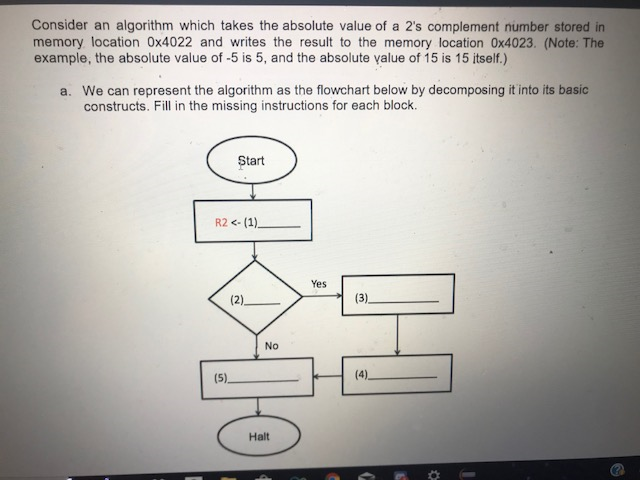
Question: Consider an algorithm which takes the absolute value of a 2's complement number stored in memory location 0x4022 and writes the result to the memory
Consider an algorithm which takes the absolute value of a 2's complement number stored in
memory location 0x4022 and writes the result to the memory location 0x4023. (Note: The
example, the absolute value of -5 is 5, and the absolute value of 15 is 15 itself.)
a. We can represent the algorithm as the flowchart below by decomposing it into its basic
constructs. Fill in the missing instructions for each block.
b)
Convert the above algorithm to an LC-3 program. Write the program in LC-3 binary code
with comment. The program should start at memory address x3000. (Hint: use LDI and
STI to access memory locations)
Consider an algorithm which takes the absolute value of a 2's complement number stored in memory location Ox4022 and writes the result to the memory location Ox4023. (Note: The example, the absolute value of -5 is 5, and the absolute value of 15 is 15 itself.) a. We can represent the algorithm as the flowchart below by decomposing it into its basic constructs. Fill in the missing instructions for each block. Start R2
Step by Step Solution
There are 3 Steps involved in it

Get step-by-step solutions from verified subject matter experts
 Study Help