







Question: A set U of n clients/servers is labeled 1, 2,..., n. A quorum Q is defined as a nonempty subset of the set {1,
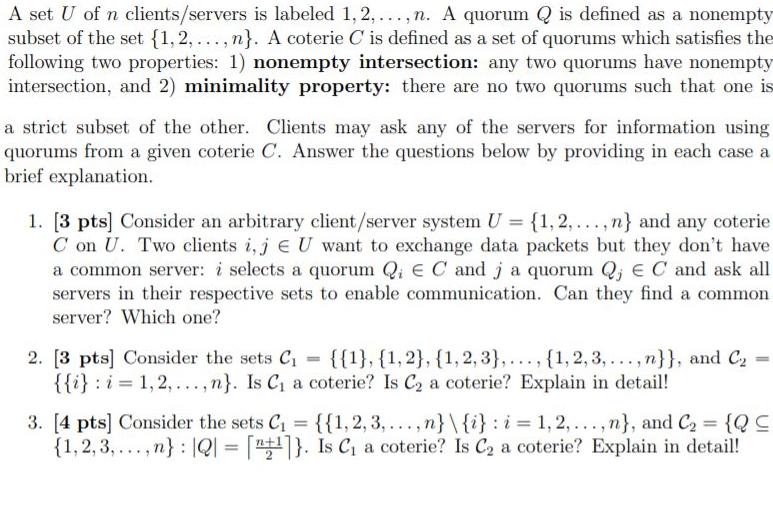
A set U of n clients/servers is labeled 1, 2,..., n. A quorum Q is defined as a nonempty subset of the set {1, 2, ..., n}. A coterie C is defined as a set of quorums which satisfies the following two properties: 1) nonempty intersection: any two quorums have nonempty intersection, and 2) minimality property: there are no two quorums such that one is a strict subset of the other. Clients may ask any of the servers for information using quorums from a given coterie C. Answer the questions below by providing in each case a brief explanation. 1. [3 pts] Consider an arbitrary client/server system U = {1,2, ...,n} and any coterie C on U. Two clients i, j e U want to exchange data packets but they don't have a common server: i selects a quorum Q. E C and ja quorum Q, E C and ask all servers in their respective sets to enable communication. Can they find a common server? Which one? 2. [3 pts] Consider the sets C, {{1}, {1,2}, {1,2, 3},..., {1,2, 3, ...,n}}, and C2 {{i} : i = 1, 2, ..., n}. Is C1 a coterie? Is C2 a coterie? Explain in detail! 3. [4 pts] Consider the sets C1 = {{1,2, 3, ...,n}\{i} : i = 1, 2, ..., n}, and C2 = {Q S {1,2, 3, ...,n} : |QI = []}. Is C a coterie? Is C2 a coterie? Explain in detail! %3D
Step by Step Solution
3.45 Rating (152 Votes )
There are 3 Steps involved in it

Get step-by-step solutions from verified subject matter experts
 Study Help