



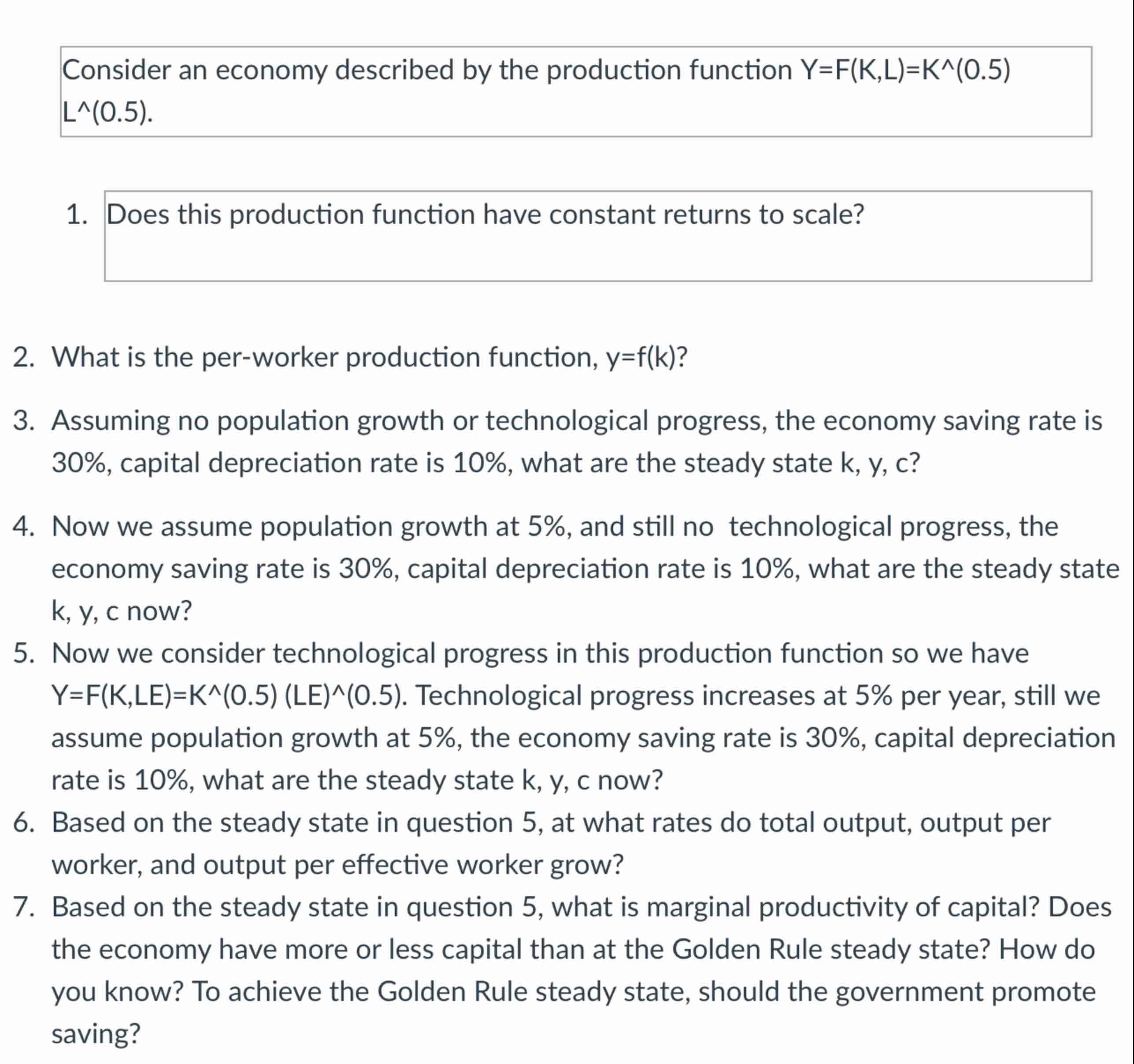
Question: Consider an economy described by the production function Y = F ( K , L ) = K ^ ( 0 . 5 ) L
Consider an economy described by the production functionYFKLK L
Does this production function have constant returns to scale?
What is the perworker production function,yfk
Assuming no population growth or technological progress, the economy saving rate is capital depreciation rate is what are the steady state k y c
Now we assume population growth at and still no technological progress, the economy saving rate is capital depreciation rate is what are the steady state k y c now?
Now we consider technological progress in this production function so we have YFKLEKLE Technological progress increases at per year, still we assume population growth at the economy saving rate is capital depreciation rate is what are the steady state k y c now?
Based on the steady state in question at what rates do total output, output per worker, and output per effective worker grow?
Based on the steady state in question what is marginal productivity of capital? Does the economy have more or less capital than at the Golden Rule steady state? How do you know? To achieve the Golden Rule steady state, should the government promote saving? Consider an economy described by the production function mathrmYmathrmFmathrmKmathrmLmathrmKwedge L
Does this production function have constant returns to scale?
What is the perworker production function, yfk
Assuming no population growth or technological progress, the economy saving rate is capital depreciation rate is what are the steady state mathrmkmathrmymathrmc
Now we assume population growth at and still no technological progress, the economy saving rate is capital depreciation rate is what are the steady state k y c now?
Now we consider technological progress in this production function so we have mathrmYmathrmFmathrmKmathrmLEmathrmKwedgemathrmLEwedge Technological progress increases at per year, still we assume population growth at the economy saving rate is capital depreciation rate is what are the steady state mathrmkmathrmymathrmc now?
Based on the steady state in question at what rates do total output, output per worker, and output per effective worker grow?
Based on the steady state in question what is marginal productivity of capital? Does the economy have more or less capital than at the Golden Rule steady state? How do you know? To achieve the Golden Rule steady state, should the government promote saving?
Step by Step Solution
There are 3 Steps involved in it
1 Expert Approved Answer
Step: 1 Unlock

Question Has Been Solved by an Expert!
Get step-by-step solutions from verified subject matter experts
Step: 2 Unlock
Step: 3 Unlock