







Question: Consider an election with 6 candidates A, B, C, D, E, and F. Suppose voters come in the following types and proportions: Type 1
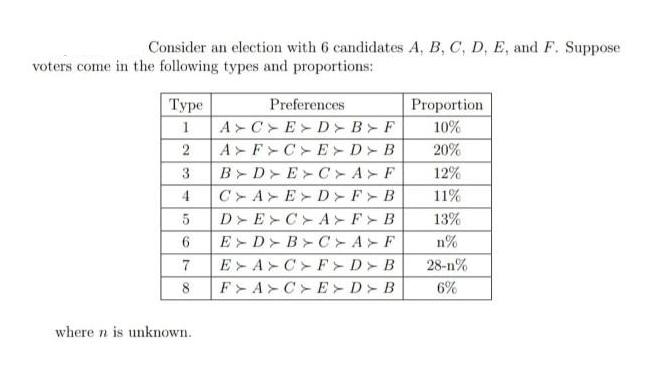
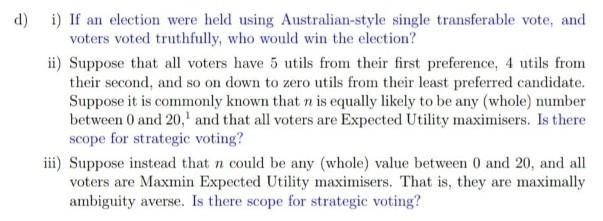
Consider an election with 6 candidates A, B, C, D, E, and F. Suppose voters come in the following types and proportions: Type 1 A>C>E>D> B> F 2 AF CE>D> B 3 B>D>EXC> A > F 4 CAED> F >B Preferences 5 D>EXCA > F > B E>D> B>C> A > F 6 EXACF>D>B FACE>D> B 7 8 where n is unknown. Proportion 10% 20% 12% 11% 13% n% 28-n% 6% d) i) If an election were held using Australian-style single transferable vote, and voters voted truthfully, who would win the election? ii) Suppose that all voters have 5 utils from their first preference, 4 utils from their second, and so on down to zero utils from their least preferred candidate. Suppose it is commonly known that n is equally likely to be any (whole) number between 0 and 20, and that all voters are Expected Utility maximisers. Is there scope for strategic voting? iii) Suppose instead that n could be any (whole) value between 0 and 20, and all voters are Maxmin Expected Utility maximisers. That is, they are maximally ambiguity averse. Is there scope for strategic voting?
Step by Step Solution
There are 3 Steps involved in it
A B AC D ACF G D E G H What is the key as AC and F are not on the RHS ... View full answer

Get step-by-step solutions from verified subject matter experts
 Study Help