







Question: Consider an electron in the double potential well shown in Fig. 1. (a) Draw the ground state wavefunction, vr (right) and UL (left), for each
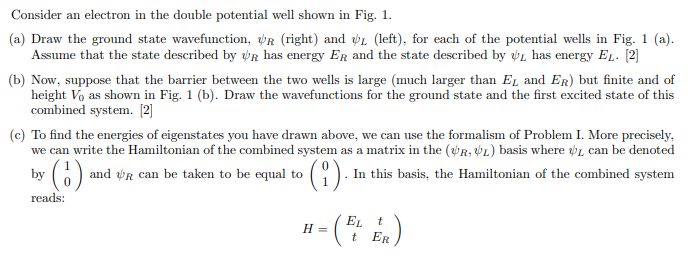
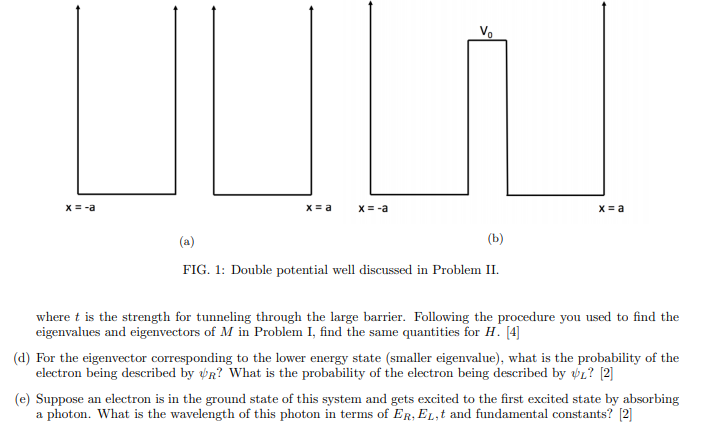
Consider an electron in the double potential well shown in Fig. 1. (a) Draw the ground state wavefunction, vr (right) and UL (left), for each of the potential wells in Fig. 1 (a). Assume that the state described by VR has energy Er and the state described by UL has energy EL. [2] (b) Now, suppose that the barrier between the two wells is large much larger than E, and Er) but finite and of height V, as shown in Fig. 1 (b). Draw the wavefunctions for the ground state and the first excited state of this combined system. [2] (c) To find the energies of eigenstates you have drawn above, we can use the formalism of Problem I. More precisely, we can write the Hamiltonian of the combined system as a matrix in the (UR, UL) basis where UL can be denoted by () and n can be taken to be equal to ( ). In this basis, the Hamiltonian of the combined system (PER) reads: H= V. X = -a X = a X = -a X = a (a) (b) FIG. 1: Double potential well discussed in Problem II. where t is the strength for tunneling through the large barrier. Following the procedure you used to find the eigenvalues and eigenvectors of Min Problem I, find the same quantities for H. [4] (d) For the eigenvector corresponding to the lower energy state (smaller eigenvalue), what is the probability of the electron being described by Vr? What is the probability of the electron being described by vz? [2] (e) Suppose an electron is in the ground state of this system and gets excited to the first excited state by absorbing a photon. What is the wavelength of this photon in terms of ER, EL,t and fundamental constants? [2] Consider an electron in the double potential well shown in Fig. 1. (a) Draw the ground state wavefunction, vr (right) and UL (left), for each of the potential wells in Fig. 1 (a). Assume that the state described by VR has energy Er and the state described by UL has energy EL. [2] (b) Now, suppose that the barrier between the two wells is large much larger than E, and Er) but finite and of height V, as shown in Fig. 1 (b). Draw the wavefunctions for the ground state and the first excited state of this combined system. [2] (c) To find the energies of eigenstates you have drawn above, we can use the formalism of Problem I. More precisely, we can write the Hamiltonian of the combined system as a matrix in the (UR, UL) basis where UL can be denoted by () and n can be taken to be equal to ( ). In this basis, the Hamiltonian of the combined system (PER) reads: H= V. X = -a X = a X = -a X = a (a) (b) FIG. 1: Double potential well discussed in Problem II. where t is the strength for tunneling through the large barrier. Following the procedure you used to find the eigenvalues and eigenvectors of Min Problem I, find the same quantities for H. [4] (d) For the eigenvector corresponding to the lower energy state (smaller eigenvalue), what is the probability of the electron being described by Vr? What is the probability of the electron being described by vz? [2] (e) Suppose an electron is in the ground state of this system and gets excited to the first excited state by absorbing a photon. What is the wavelength of this photon in terms of ER, EL,t and fundamental constants? [2]
Step by Step Solution
There are 3 Steps involved in it

Get step-by-step solutions from verified subject matter experts
 Study Help