







Question: Consider an electronic amplifier with input voltage v(t) and output voltage vo(t). Assume that vo(t) = 8v;(t) + 2. Show that the amplifier does
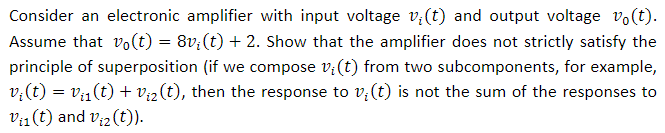
Consider an electronic amplifier with input voltage v(t) and output voltage vo(t). Assume that vo(t) = 8v;(t) + 2. Show that the amplifier does not strictly satisfy the principle of superposition (if we compose vi(t) from two subcomponents, for example, v (t) = V (t) + V2(t), then the response to v (t) is not the sum of the responses to V (t) and V2 (t)).
Step by Step Solution
★★★★★
3.46 Rating (156 Votes )
There are 3 Steps involved in it
1 Expert Approved Answer
Step: 1 Unlock

To show that the amplifier does not strictly satisfy the principle of superposition we need to check ... View full answer
Question Has Been Solved by an Expert!
Get step-by-step solutions from verified subject matter experts
Step: 2 Unlock
Step: 3 Unlock
 Study Help