







Question: Consider an elementary, irreversible, gas-phase reaction catalyzed by solid catalysts: A+ B -> 2C is carried out isothermally at 25 C in a packed-bed reactor
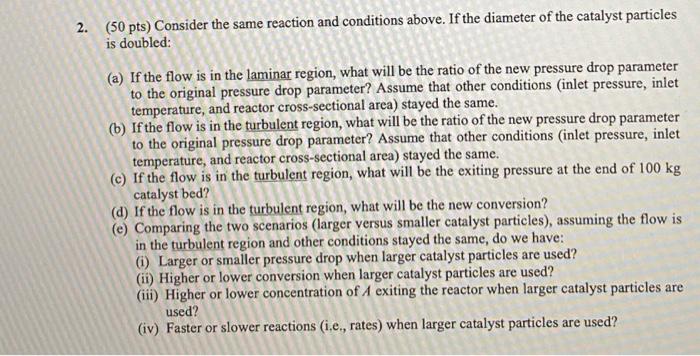
2. (50 pts) Consider the same reaction and conditions above. If the diameter of the catalyst particles is doubled: (a) If the flow is in the laminar region, what will be the ratio of the new pressure drop parameter to the original pressure drop parameter? Assume that other conditions (inlet pressure, inlet temperature, and reactor cross-sectional area) stayed the same. (b) If the flow is in the turbulent region, what will be the ratio of the new pressure drop parameter to the original pressure drop parameter? Assume that other conditions (inlet pressure, inlet temperature, and reactor cross-sectional area) stayed the same. (c) If the flow is in the turbulent region, what will be the exiting pressure at the end of 100 kg catalyst bed? (d) If the flow is in the turbulent region, what will be the new conversion? (e) Comparing the two scenarios (larger versus smaller catalyst particles), assuming the flow is in the turbulent region and other conditions stayed the same, do we have: (i) Larger or smaller pressure drop when larger catalyst particles are used? (ii) Higher or lower conversion when larger catalyst particles are used? (iii) Higher or lower concentration of A exiting the reactor when larger catalyst particles are used? (iv) Faster or slower reactions (i.e., rates) when larger catalyst particles are used? con that will be
Step by Step Solution
There are 3 Steps involved in it

Get step-by-step solutions from verified subject matter experts
 Study Help