







Question: Consider an exogenous increase in real money demand ( e . g . , a substantial decrease in credit card usage ) in a closed
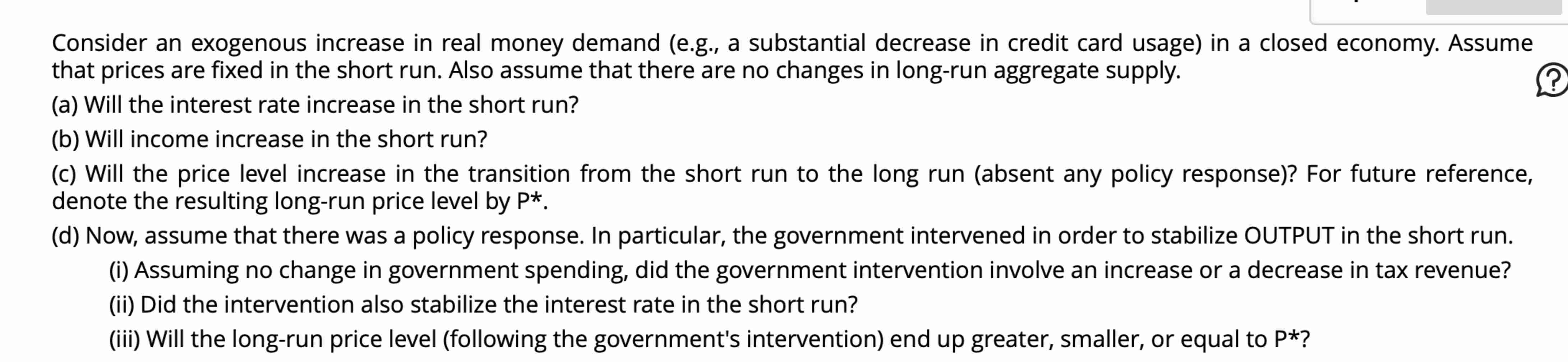
Consider an exogenous increase in real money demand eg a substantial decrease in credit card usage in a closed economy. Assume that prices are fixed in the short run. Also assume that there are no changes in longrun aggregate supply.
a Will the interest rate increase in the short run?
b Will income increase in the short run?
c Will the price level increase in the transition from the short run to the long run absent any policy response For future reference, denote the resulting longrun price level by mathrmP
d Now, assume that there was a policy response. In particular, the government intervened in order to stabilize OUTPUT in the short run.
i Assuming no change in government spending, did the government intervention involve an increase or a decrease in tax revenue?
ii Did the intervention also stabilize the interest rate in the short run?
iii Will the longrun price level following the government's intervention end up greater, smaller, or equal to mathrmP
Step by Step Solution
There are 3 Steps involved in it
1 Expert Approved Answer
Step: 1 Unlock

Question Has Been Solved by an Expert!
Get step-by-step solutions from verified subject matter experts
Step: 2 Unlock
Step: 3 Unlock
 Study Help