







Question: Consider an import tariff-setting game between three countries, Alexandria (A), Burmecia (B), and Cleyra (C). A is a large country so imposing an import tariff
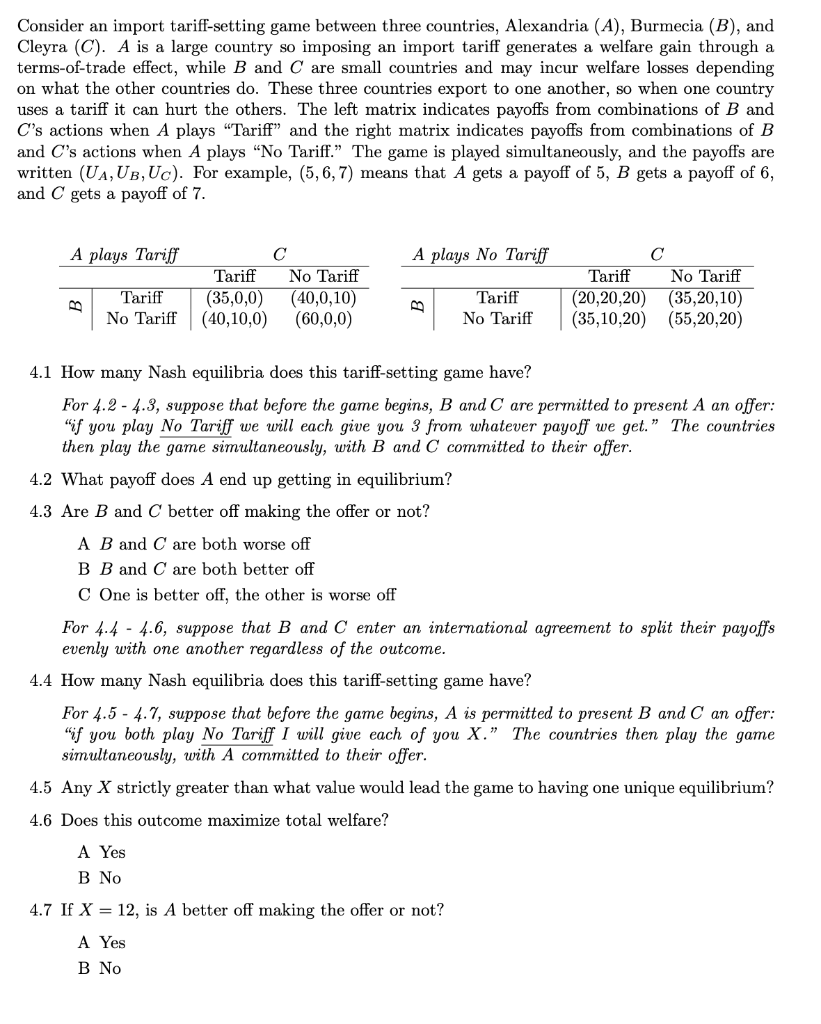
Consider an import tariff-setting game between three countries, Alexandria (A), Burmecia (B), and Cleyra (C). A is a large country so imposing an import tariff generates a welfare gain through a terms-of-trade effect, while B and C are small countries and may incur welfare losses depending on what the other countries do. These three countries export to one another, so when one country uses a tariff it can hurt the others. The left matrix indicates payoffs from combinations of B and C's actions when A plays "Tariff and the right matrix indicates payoffs from combinations of B and C's actions when A plays No Tariff. The game is played simultaneously, and the payoffs are written (UA, UB, Uc). For example, (5,6,7) means that A gets a payoff of 5, B gets a payoff of 6, and C gets a payoff of 7. A plays Tariff A plays No Tariff Tariff No Tariff Tariff (35,0,0) (40,10,0) No Tariff (40,0,10) (60,0,0) Tariff No Tariff (20,20,20) (35,20,10) (35,10,20) (55,20,20) Tariff No Tariff 4.1 How many Nash equilibria does this tariff-setting game have? For 4.2 - 4.3, suppose that before the game begins, B and C are permitted to present A an offer: "if you play No Tariff we will each give you 3 from whatever payoff we get. The countries then play the game simultaneously, with B and C committed to their offer. 4.2 What payoff does A end up getting in equilibrium? 4.3 Are B and C better off making the offer or not? A B and C are both worse off B B and C are both better off C One is better off, the other is worse off For 4.4 - 4.6, suppose that B and Center an international agreement to split their payoffs evenly with one another regardless of the outcome. 4.4 How many Nash equilibria does this tariff-setting game have? For 4.5 - 4.7, suppose that before the game begins, A is permitted to present B and C an offer: "if you both play No Tariff I will give each of you X. The countries then play the game simultaneously, with A committed to their offer. 4.5 Any X strictly greater than what value would lead the game to having one unique equilibrium? 4.6 Does this outcome maximize total welfare? A Yes B No 4.7 If X = 12, is A better off making the offer or not? A Yes B No Consider an import tariff-setting game between three countries, Alexandria (A), Burmecia (B), and Cleyra (C). A is a large country so imposing an import tariff generates a welfare gain through a terms-of-trade effect, while B and C are small countries and may incur welfare losses depending on what the other countries do. These three countries export to one another, so when one country uses a tariff it can hurt the others. The left matrix indicates payoffs from combinations of B and C's actions when A plays "Tariff and the right matrix indicates payoffs from combinations of B and C's actions when A plays No Tariff. The game is played simultaneously, and the payoffs are written (UA, UB, Uc). For example, (5,6,7) means that A gets a payoff of 5, B gets a payoff of 6, and C gets a payoff of 7. A plays Tariff A plays No Tariff Tariff No Tariff Tariff (35,0,0) (40,10,0) No Tariff (40,0,10) (60,0,0) Tariff No Tariff (20,20,20) (35,20,10) (35,10,20) (55,20,20) Tariff No Tariff 4.1 How many Nash equilibria does this tariff-setting game have? For 4.2 - 4.3, suppose that before the game begins, B and C are permitted to present A an offer: "if you play No Tariff we will each give you 3 from whatever payoff we get. The countries then play the game simultaneously, with B and C committed to their offer. 4.2 What payoff does A end up getting in equilibrium? 4.3 Are B and C better off making the offer or not? A B and C are both worse off B B and C are both better off C One is better off, the other is worse off For 4.4 - 4.6, suppose that B and Center an international agreement to split their payoffs evenly with one another regardless of the outcome. 4.4 How many Nash equilibria does this tariff-setting game have? For 4.5 - 4.7, suppose that before the game begins, A is permitted to present B and C an offer: "if you both play No Tariff I will give each of you X. The countries then play the game simultaneously, with A committed to their offer. 4.5 Any X strictly greater than what value would lead the game to having one unique equilibrium? 4.6 Does this outcome maximize total welfare? A Yes B No 4.7 If X = 12, is A better off making the offer or not? A Yes B No
Step by Step Solution
There are 3 Steps involved in it

Get step-by-step solutions from verified subject matter experts
 Study Help