







Question: Consider an infinitesimal uniformly stressed rectangular element extracted from a material body in a state of plane stress. yx X dy dx dx (a) (b)
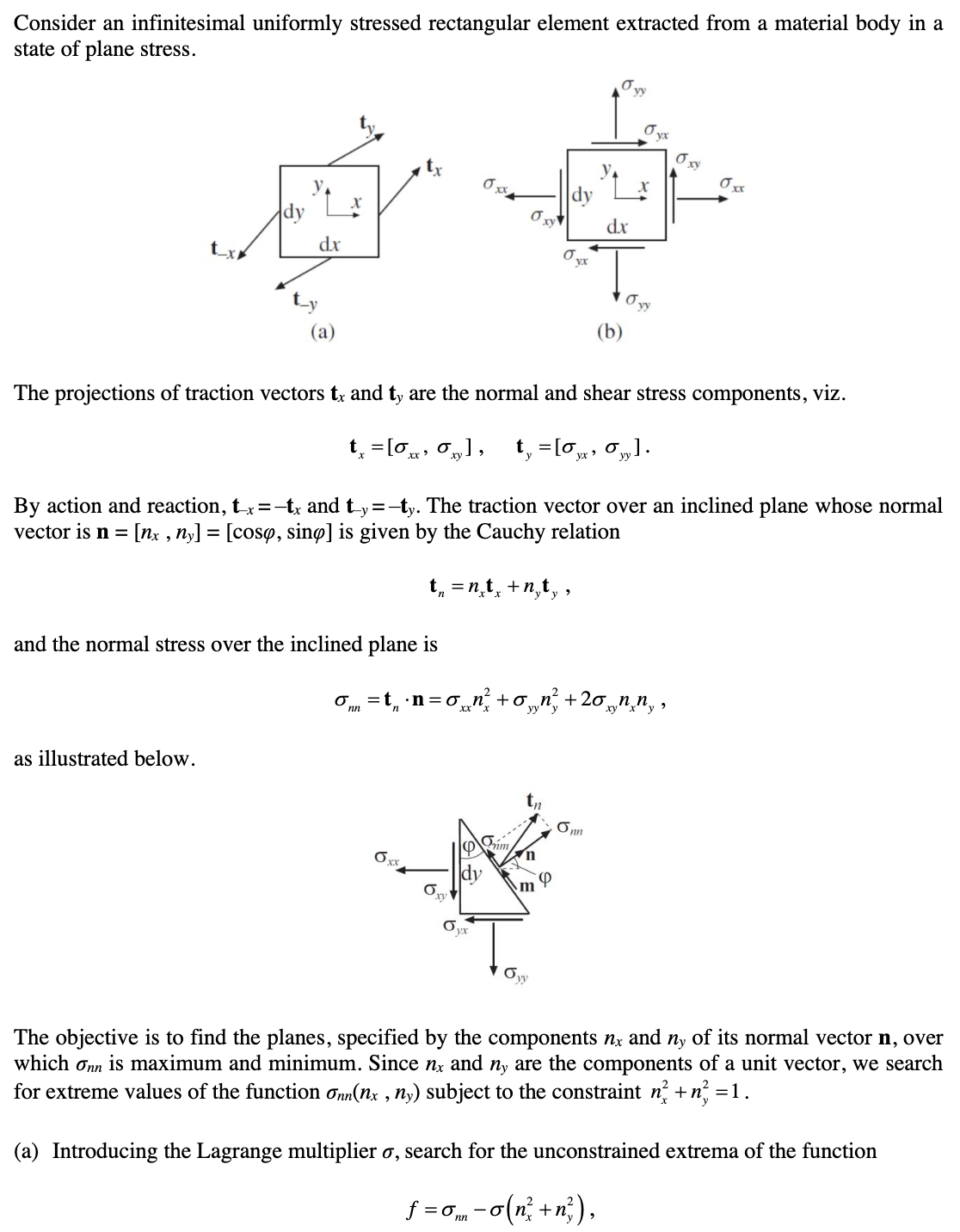
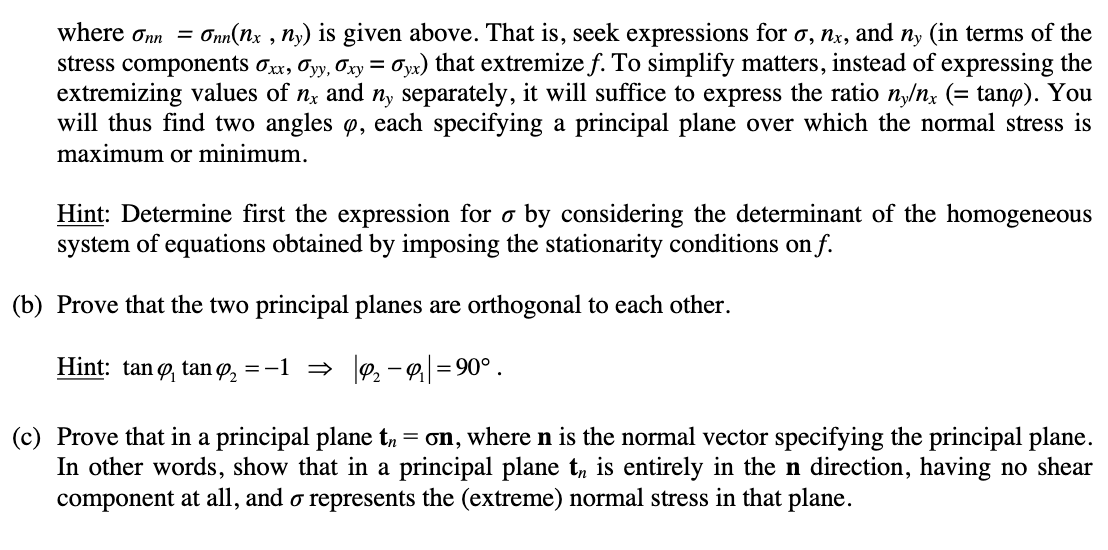
Consider an infinitesimal uniformly stressed rectangular element extracted from a material body in a state of plane stress. yx X dy dx dx (a) (b) The projections of traction vectors to and ty are the normal and shear stress components, viz. t, = [0 x, On], t, = [0,x, Ow]. By action and reaction, tx=-tx and ty=-ty. The traction vector over an inclined plane whose normal vector is n = [nx , ny] = [cosp, sing] is given by the Cauchy relation t, = n,t, +n,t,, and the normal stress over the inclined plane is On =t, 'n=own +on, +20 nn,, as illustrated below. Oxx Ov The objective is to find the planes, specified by the components nx and ny of its normal vector n, over which onn is maximum and minimum. Since nx and ny are the components of a unit vector, we search for extreme values of the function Onn(nx , ny) subject to the constraint n, +n, =1. (a) Introducing the Lagrange multiplier o, search for the unconstrained extrema of the function f =0 m - o(n, +n,),(b) (C) where am, = ammx , try) is given above. That is, seek expressions for a, m, and ny (in terms of the stress components an, a\
Step by Step Solution
There are 3 Steps involved in it

Get step-by-step solutions from verified subject matter experts
 Study Help