







Question: Consider an instance of the satisfiability Problem, specified by clauses C_1, .., C_k over a set of Boolean variables x_1, ..., x_n We say that
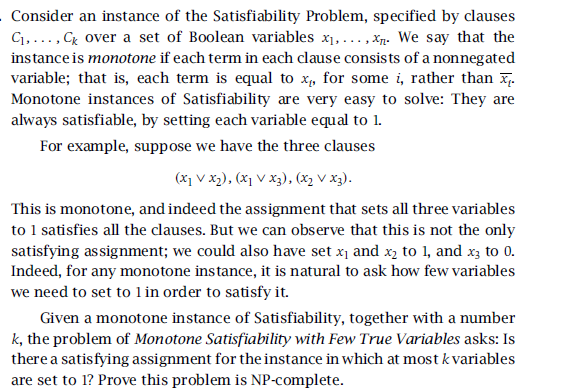
Consider an instance of the satisfiability Problem, specified by clauses C_1, .., C_k over a set of Boolean variables x_1, ..., x_n We say that the instance is monotone if each term in each clause consists of a nonnegated variable: that is, each term is equal to x_i, for some i, rather than x bar i. Monotone instances of Satisfiability are very easy to solve: They are always satisfiable, by setting each variable equal to 1. For example, suppose we have the three clauses (x_1 x_2), (x_1 x_3), (x_2 x_3). This is monotone, and indeed the assignment that sets all three variables to 1 satisfies all the clauses. But we can observe that this is not the only satisfying assignment: we could also have set x_1 and to x_2, and x_3 to 0. Indeed, for any monotone instance, it is natural to ask how few variables we need to set to 1 in order to satisfy it. Given a monotone instance of Satisfiability, together with a number k, the problem of Monotone Satisfiability with Few True Variables asks: Is there a satisfying assignment for the instance in which at most k variables are set to 1? Prove this problem is NP-complete
Step by Step Solution
There are 3 Steps involved in it

Get step-by-step solutions from verified subject matter experts
 Study Help