







Question: Consider an On-Off Keying (OOK) communication system, where we either transmit x = 0 or x = 5. At the receiver side, detecting if a
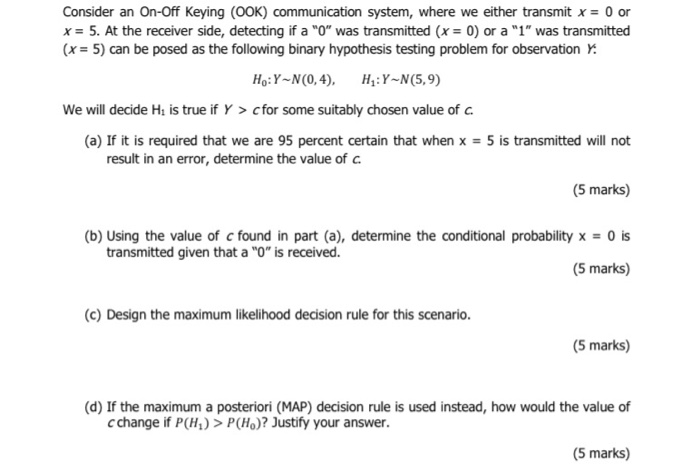
Consider an On-Off Keying (OOK) communication system, where we either transmit x = 0 or x = 5. At the receiver side, detecting if a "0" was transmitted (x = 0) or a "1" was transmitted (x = 5) can be posed as the following binary hypothesis testing problem for observation Y. H:Y-N(0, 4), HN:Y-N(5,9) We will decide Hy is true if Y > cfor some suitably chosen value of c. (a) If it is required that we are 95 percent certain that when x = 5 is transmitted will not result in an error, determine the value of c. (5 marks) (b) Using the value of c found in part (a), determine the conditional probability x = 0 is transmitted given that a "0" is received. (5 marks) (c) Design the maximum likelihood decision rule for this scenario. (5 marks) (d) If the maximum a posteriori (MAP) decision rule is used instead, how would the value of c change if P(H) > P(H)? Justify your answer. (5 marks) Consider an On-Off Keying (OOK) communication system, where we either transmit x = 0 or x = 5. At the receiver side, detecting if a "0" was transmitted (x = 0) or a "1" was transmitted (x = 5) can be posed as the following binary hypothesis testing problem for observation Y. H:Y-N(0, 4), HN:Y-N(5,9) We will decide Hy is true if Y > cfor some suitably chosen value of c. (a) If it is required that we are 95 percent certain that when x = 5 is transmitted will not result in an error, determine the value of c. (5 marks) (b) Using the value of c found in part (a), determine the conditional probability x = 0 is transmitted given that a "0" is received. (5 marks) (c) Design the maximum likelihood decision rule for this scenario. (5 marks) (d) If the maximum a posteriori (MAP) decision rule is used instead, how would the value of c change if P(H) > P(H)? Justify your
Step by Step Solution
There are 3 Steps involved in it

Get step-by-step solutions from verified subject matter experts
 Study Help