



Question: Consider an optimal growth model in which output is produced with capital and labor: a = AKfLi' (1) where L: denotes hours worked, A 2)
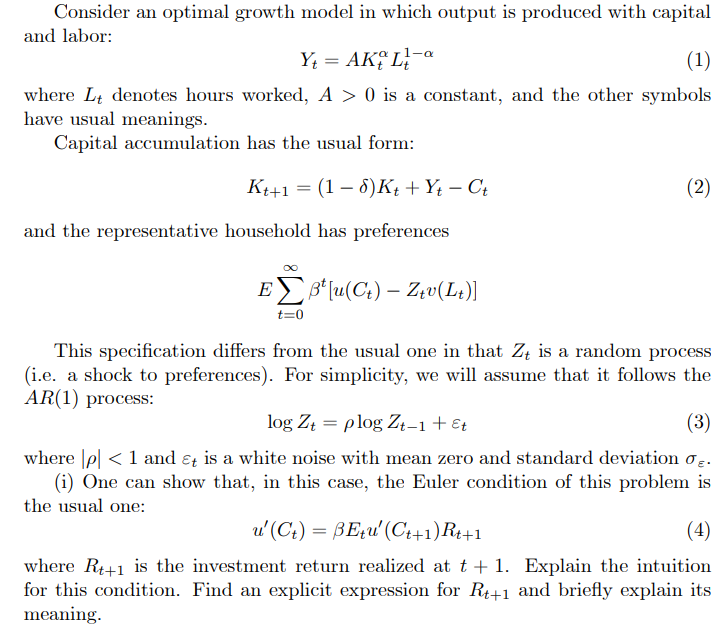
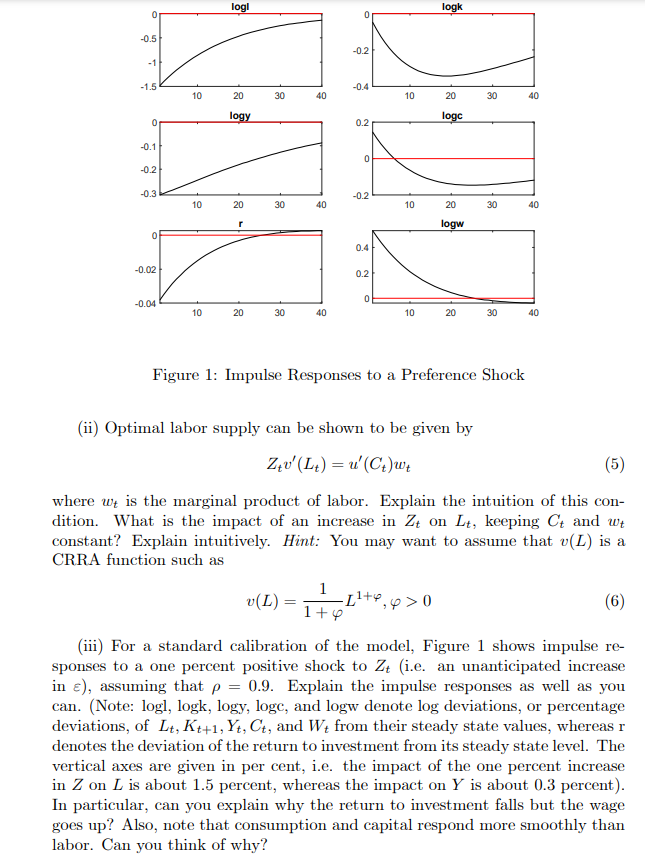
Consider an optimal growth model in which output is produced with capital and labor: a = AKfLi'\" (1) where L: denotes hours worked, A 2) I} is a constant, and the other symbols have usual meanings. IGapital accumulation has the usual form: Kt+1 = [1 5)Kt+YtCt [2} and the representative household has preferences 52 t[(0tl Zt'viLtl] t= This specication differs from the usual one in that Z: is a random process (Le. a shock to preferences). For simplicity, we will assume that it follows the 1113(1) process: 105 Z: = 9103 Ztl + E: [3) where I pl { l and at is a white noise with mean zero and standard deviation :35. (i) One can show that, in this case, the Euler condition of this problem is the usual one: \"'(Ctl = Etu'{Ct+1)Rt+1 [4} where Rt+1 is the investment return realized at t + 1. Explain the intuition for this condition. Find an explicit expression for Rt+1 and briey explain its meaning. Figure 1: Impulse Responses to a Reference Shock (ii) Optimal labor supply can be shown to be given by 3:9!{Lt} = u"{C,}wt [5} where He is the marginal product of labor. Explain the intuition of this con dition. What is the impact of an increase in E; on Lt, keeping C: and tot constant? Explain intuitively. Hint: You may want to assume that a{L} is a CRRA function such as 1 UiL} = le+P, [P 33' {6'} {iii} Fer a standard calibration of the model, Figure 1 shows impulse re sponses to a one percent positive shock to E; {i.e. an unanticipated increase in E], aSSuming that p = [1.9. Explain the impulse reapenaea as well as you can. (Note: logl, logk, logy, logo, and logw denote log deviations, or percentage deviations, of Lt, If,\" , Kg, 0,, and Wt from their steady state values, whereas r denotes the deviation of the return to investment from its steady state level. The vertical axes are given in per cent, i.e. the impact of the one percent increase in Z on L is about 1.5 percent, whereas the impact on Y is about [1.3 percent}. In particular, can you explain why the return to investment falls but the wage goes up? Also, note that cenSuniption and capital respond more srnoothly than labor. Can you think of why
Step by Step Solution
There are 3 Steps involved in it

Get step-by-step solutions from verified subject matter experts