







Question: Consider an orbital angular momentum I (I is an integer and positive or zero) and a spin s with s = 1/2. The tensor
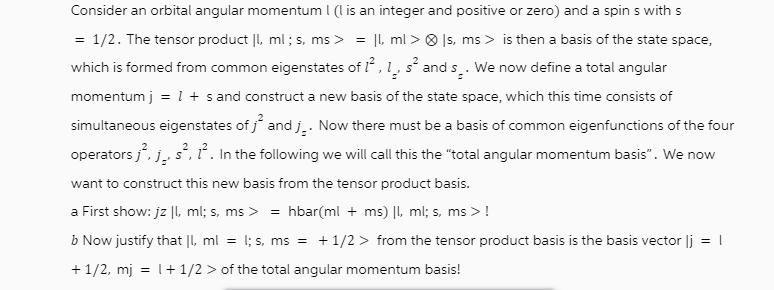
Consider an orbital angular momentum I (I is an integer and positive or zero) and a spin s with s = 1/2. The tensor product II, ml; s. ms > = l, ml> |s, ms> is then a basis of the state space, which is formed from common eigenstates of 12, 1, s and s. We now define a total angular momentum j = 1 + s and construct a new basis of the state space, which this time consists of simultaneous eigenstates of j and j. Now there must be a basis of common eigenfunctions of the four operators j, j, s, 1. In the following we will call this the "total angular momentum basis". We now want to construct this new basis from the tensor product basis. a First show: jz |I, ml; s, ms > = hbar(ml + ms) |l, ml; s, ms > ! b Now justify that II, ml = 1; s, ms = +1/2> from the tensor product basis is the basis vector lj = 1 + 1/2, mj = 1 + 1/2> of the total angular momentum basis!
Step by Step Solution
3.39 Rating (158 Votes )
There are 3 Steps involved in it
First lets clarify the notation mi represents the eigenvalue of the zcomponent of the orbital angula... View full answer

Get step-by-step solutions from verified subject matter experts
 Study Help