







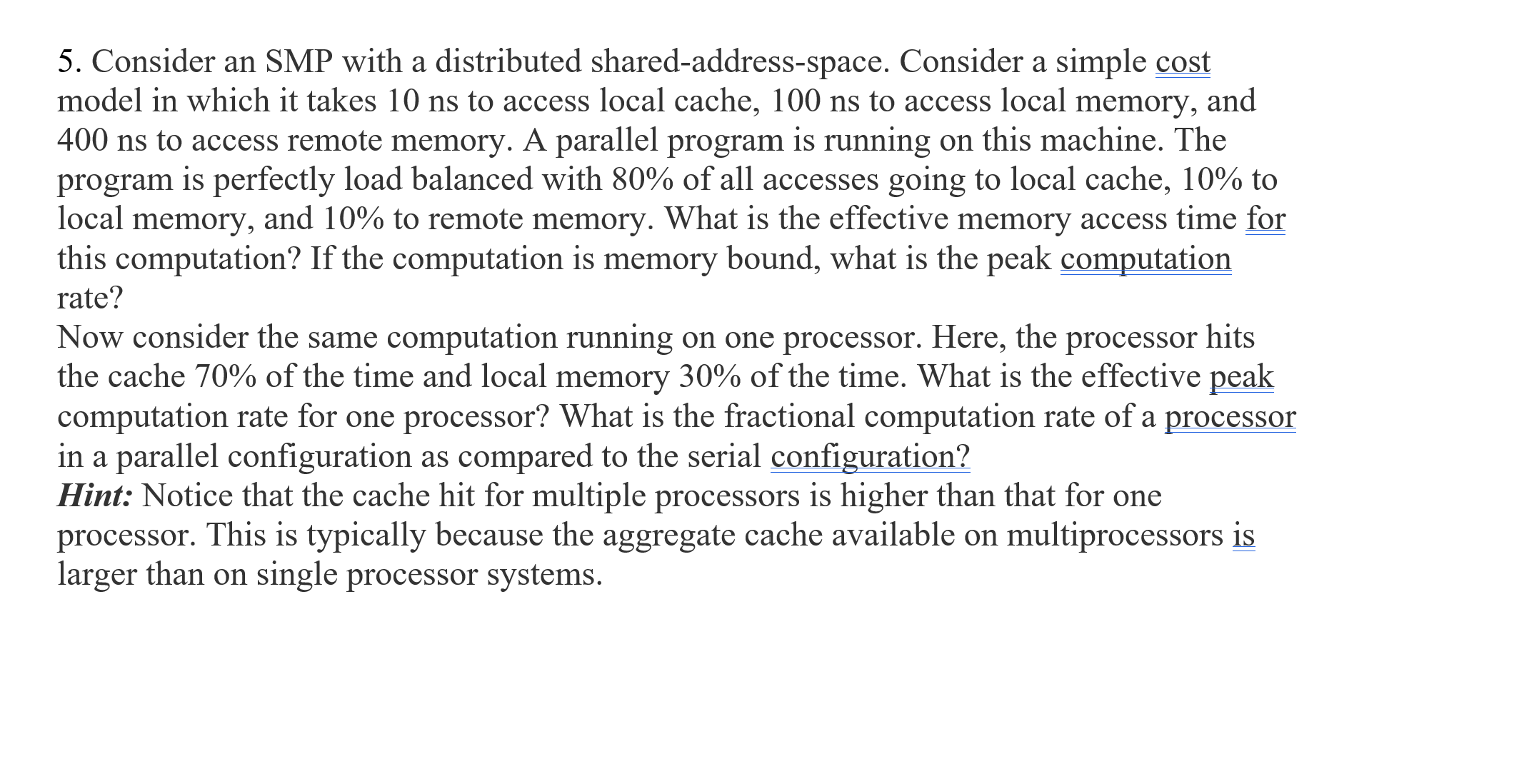
Question: Consider an SMP with a distributed shared - address - space. Consider a simple cost model in which it takes 1 0 n s to
Consider an SMP with a distributed sharedaddressspace. Consider a simple cost
model in which it takes to access local cache, to access local memory, and
to access remote memory. A parallel program is running on this machine. The
program is perfectly load balanced with of all accesses going to local cache, to
local memory, and to remote memory. What is the effective memory access time for
this computation? If the computation is memory bound, what is the peak computation
rate?
Now consider the same computation running on one processor. Here, the processor hits
the cache of the time and local memory of the time. What is the effective peak
computation rate for one processor? What is the fractional computation rate of a processor
in a parallel configuration as compared to the serial configuration?
Hint: Notice that the cache hit for multiple processors is higher than that for one
processor. This is typically because the aggregate cache available on multiprocessors is
larger than on single processor systems.
Step by Step Solution
There are 3 Steps involved in it
1 Expert Approved Answer
Step: 1 Unlock

Question Has Been Solved by an Expert!
Get step-by-step solutions from verified subject matter experts
Step: 2 Unlock
Step: 3 Unlock
 Study Help