



Question: Consider electronic components mounted on the inner surface of a cylindrical tube. The components are cooled by air flowing through the hollow center of
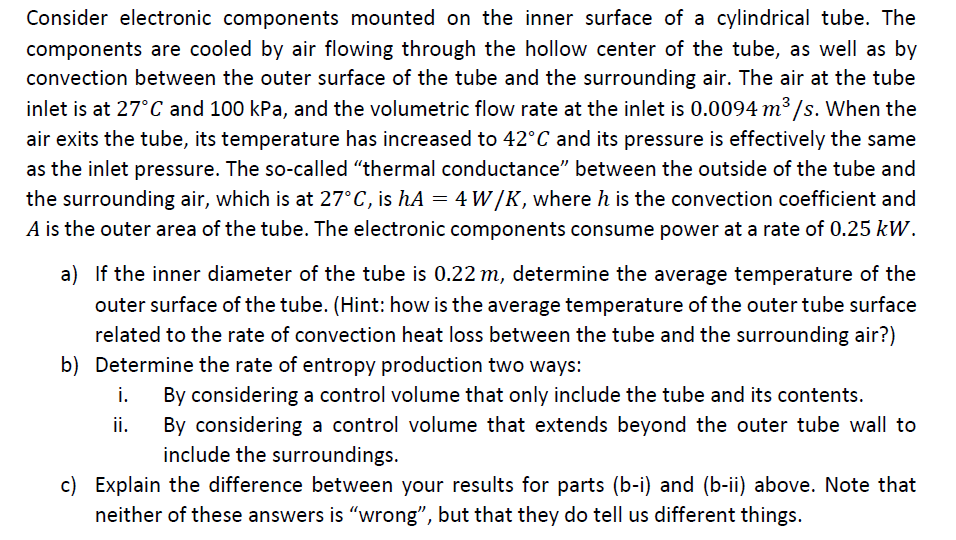
Consider electronic components mounted on the inner surface of a cylindrical tube. The components are cooled by air flowing through the hollow center of the tube, as well as by convection between the outer surface of the tube and the surrounding air. The air at the tube inlet is at 27C and 100 kPa, and the volumetric flow rate at the inlet is 0.0094 m/s. When the air exits the tube, its temperature has increased to 42C and its pressure is effectively the same as the inlet pressure. The so-called "thermal conductance" between the outside of the tube and the surrounding air, which is at 27C, is hA = 4W/K, where h is the convection coefficient and A is the outer area of the tube. The electronic components consume power at a rate of 0.25 kW. a) If the inner diameter of the tube is 0.22 m, determine the average temperature of the outer surface of the tube. (Hint: how is the average temperature of the outer tube surface related to the rate of convection heat loss between the tube and the surrounding air?) b) Determine the rate of entropy production two ways: i. ii. By considering a control volume that only include the tube and its contents. By considering a control volume that extends beyond the outer tube wall to include the surroundings. c) Explain the difference between your results for parts (b-i) and (b-ii) above. Note that neither of these answers is "wrong", but that they do tell us different things.
Step by Step Solution
There are 3 Steps involved in it
a To determine the average temperature of the outer surface of the tube we can use the energy balance equation for the tube and its contents The rate of convection heat loss between the tube and the s... View full answer

Get step-by-step solutions from verified subject matter experts