







Question: Consider flow in a stream with depth h o = 4 m and Froude number F o = 1 8 . In what follows we
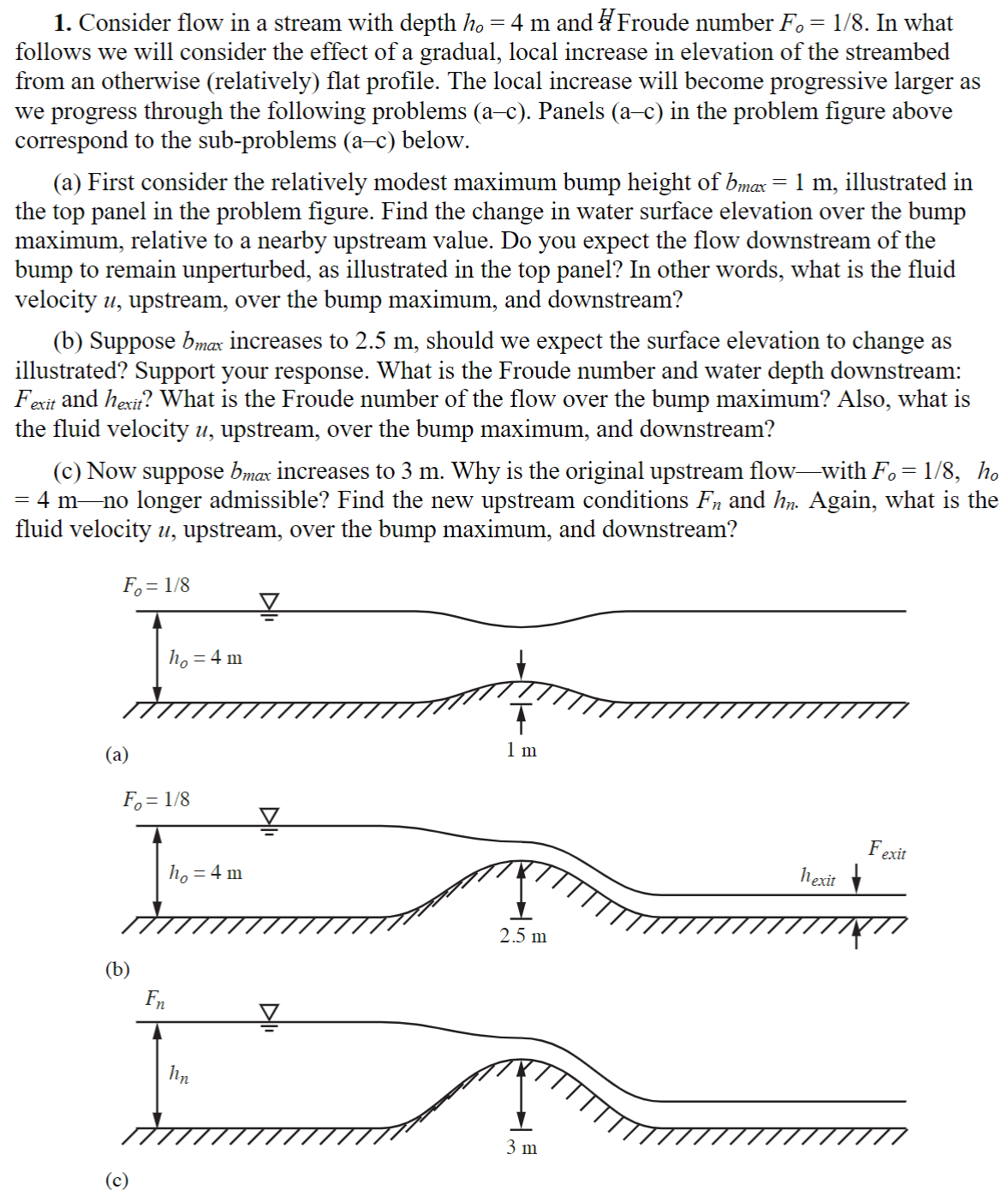
Consider flow in a stream with depth and Froude number In what follows we will consider the effect of a gradual, local increase in elevation of the streambedfrom an otherwise relatively flat profile. The local increase will become progressive larger as we progress through the following problems Panels in the problem figure above correspond to the subproblems below.
a First consider the relatively modest maximum bump height of illustrated in the top panel in the problem figure. Find the change in water surface elevation over the bump maximum, relative to a nearby upstream value. Do you expect the flow downstream of the bump to remain unperturbed, as illustrated in the top panel? In other words, what is the fluid velocity upstream, over the bump maximum, and downstream?
b Suppose increases to should we expect the surface elevation to change as illustrated? Support your response. What is the Froude number and water depth downstream: and What is the Froude number of the flow over the bump maximum? Also, what is the fluid velocity upstream, over the bump maximum, and downstream?
c Now suppose increases to Why is the original upstream flowwith no longer admissible? Find the new upstream conditions and Again, what is the fluid velocity upstream, over the bump maximum, and downstream?
Step by Step Solution
There are 3 Steps involved in it
1 Expert Approved Answer
Step: 1 Unlock

Question Has Been Solved by an Expert!
Get step-by-step solutions from verified subject matter experts
Step: 2 Unlock
Step: 3 Unlock
 Study Help