







Question: Consider the AK model in which we do not normalize the size of the labor force to one. (a) Using the production function in equation
Consider the AK model in which we do not normalize the size of the labor force to one.
(a) Using the production function in equation (9.5) and the standard capital accumulation equation, show that the growth rate of output depends on L.
(b) What happens if L is growing at some constant rate n?
(c) Specify the form of the externality in equation (9.4) differently to avoid this implication.
(d) Does labor affect production?
equations below : 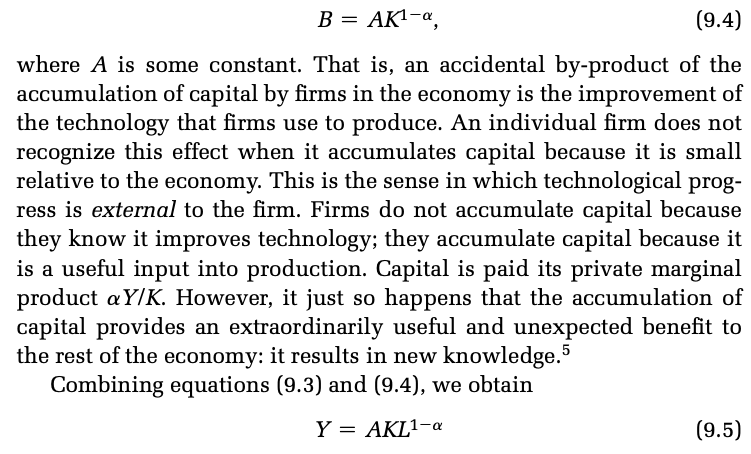
B = AK-a, (9.4) where A is some constant. That is, an accidental by-product of the accumulation of capital by firms in the economy is the improvement of the technology that firms use to produce. An individual firm does not recognize this effect when it accumulates capital because it is small relative to the economy. This is the sense in which technological prog- ress is external to the firm. Firms do not accumulate capital because they know it improves technology; they accumulate capital because it is a useful input into production. Capital is paid its private marginal product aY/K. However, it just so happens that the accumulation of capital provides an extraordinarily useful and unexpected benefit to the rest of the economy: it results in new knowledge.5 Combining equations (9.3) and (9.4), we obtain Y = AKL1-a (9.5) B = AK-a, (9.4) where A is some constant. That is, an accidental by-product of the accumulation of capital by firms in the economy is the improvement of the technology that firms use to produce. An individual firm does not recognize this effect when it accumulates capital because it is small relative to the economy. This is the sense in which technological prog- ress is external to the firm. Firms do not accumulate capital because they know it improves technology; they accumulate capital because it is a useful input into production. Capital is paid its private marginal product aY/K. However, it just so happens that the accumulation of capital provides an extraordinarily useful and unexpected benefit to the rest of the economy: it results in new knowledge.5 Combining equations (9.3) and (9.4), we obtain Y = AKL1-a (9.5)
Step by Step Solution
There are 3 Steps involved in it

Get step-by-step solutions from verified subject matter experts
 Study Help