



Question: Consider the balanced, additive, one-way ANOVA model Yj=ptoitej, i=1,..., I,j =1,....J (1) where aj ~ N(0, o ), iid., with a E R and o?
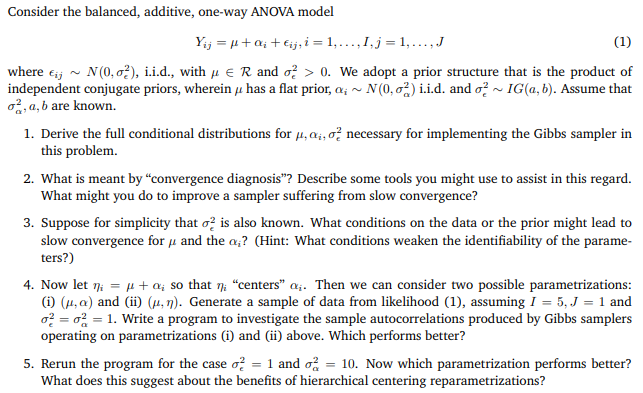
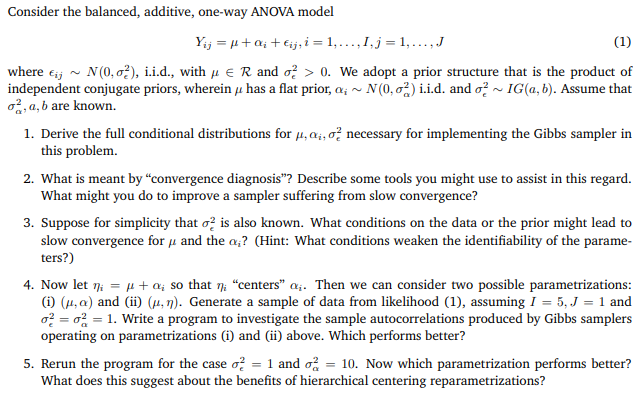
Consider the balanced, additive, one-way ANOVA model Yj=ptoitej, i=1,..., I,j =1,....J (1) where aj ~ N(0, o ), iid., with a E R and o? > 0. We adopt a prior structure that is the product of independent conjugate priors, wherein / has a flat prior, a; ~ N(0, o2) i.id. and a? ~ IG(a, b). Assume that -, a, b are known. 1. Derive the full conditional distributions for #, on, o necessary for implementing the Gibbs sampler in this problem. 2. What is meant by "convergence diagnosis"? Describe some tools you might use to assist in this regard. What might you do to improve a sampler suffering from slow convergence? 3. Suppose for simplicity that o is also known. What conditions on the data or the prior might lead to slow convergence for a and the a;? (Hint: What conditions weaken the identifiability of the parame- ters?) 4. Now let n = u + o; so that , "centers" a;. Then we can consider two possible parametrizations: (i) (u, a) and (ii) (#, 1). Generate a sample of data from likelihood (1), assuming I = 5, J = 1 and 02 =02 = 1. Write a program to investigate the sample autocorrelations produced by Gibbs samplers operating on parametrizations (i) and (ii) above. Which performs better? 5. Rerun the program for the case of = 1 and o? = 10. Now which parametrization performs better? What does this suggest about the benefits of hierarchical centering reparametrizations
Step by Step Solution
There are 3 Steps involved in it

Get step-by-step solutions from verified subject matter experts