







Question: Consider the basic setup of the Diamond-Dybvig (1983) model. Specifically, there are three periods, denoted t=0,1,2, a single consumption good, and an illiquid investment opportunity
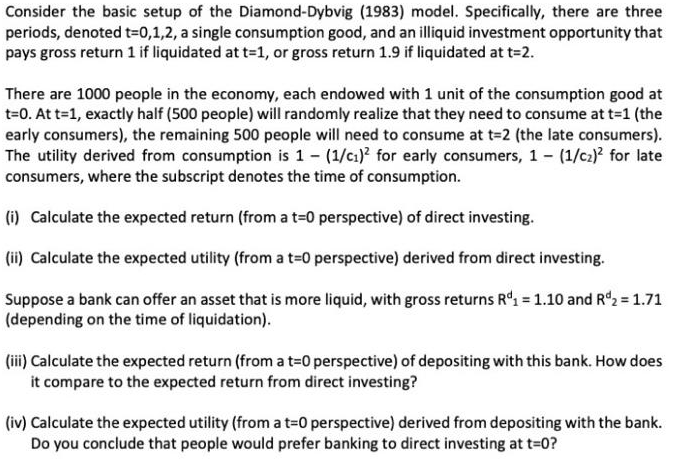
Consider the basic setup of the Diamond-Dybvig (1983) model. Specifically, there are three periods, denoted t=0,1,2, a single consumption good, and an illiquid investment opportunity that pays gross return 1 if liquidated at t=1, or gross return 1.9 if liquidated at t=2. There are 1000 people in the economy, each endowed with 1 unit of the consumption good at t=0. At t=1, exactly half (500 people) will randomly realize that they need to consume at t=1 (the early consumers), the remaining 500 people will need to consume at t=2 (the late consumers). The utility derived from consumption is 1 - (1/ci)? for early consumers, 1 - (1/cz)2 for late consumers, where the subscript denotes the time of consumption. (i) Calculate the expected return (from a t=0 perspective) of direct investing. (ii) Calculate the expected utility (from a t=0 perspective) derived from direct investing. Suppose a bank can offer an asset that is more liquid, with gross returns Rt = 1.10 and R2 = 1.71 (depending on the time of liquidation). (iii) Calculate the expected return (from a t=0 perspective) of depositing with this bank. How does it compare to the expected return from direct investing? (iv) Calculate the expected utility (from a t=0 perspective) derived from depositing with the bank. Do you conclude that people would prefer banking to direct investing at t=0? Consider the basic setup of the Diamond-Dybvig (1983) model. Specifically, there are three periods, denoted t=0,1,2, a single consumption good, and an illiquid investment opportunity that pays gross return 1 if liquidated at t=1, or gross return 1.9 if liquidated at t=2. There are 1000 people in the economy, each endowed with 1 unit of the consumption good at t=0. At t=1, exactly half (500 people) will randomly realize that they need to consume at t=1 (the early consumers), the remaining 500 people will need to consume at t=2 (the late consumers). The utility derived from consumption is 1 - (1/ci)? for early consumers, 1 - (1/cz)2 for late consumers, where the subscript denotes the time of consumption. (i) Calculate the expected return (from a t=0 perspective) of direct investing. (ii) Calculate the expected utility (from a t=0 perspective) derived from direct investing. Suppose a bank can offer an asset that is more liquid, with gross returns Rt = 1.10 and R2 = 1.71 (depending on the time of liquidation). (iii) Calculate the expected return (from a t=0 perspective) of depositing with this bank. How does it compare to the expected return from direct investing? (iv) Calculate the expected utility (from a t=0 perspective) derived from depositing with the bank. Do you conclude that people would prefer banking to direct investing at t=0
Step by Step Solution
There are 3 Steps involved in it

Get step-by-step solutions from verified subject matter experts
 Study Help