







Question: Consider the basic Solow model that we covered in class where population (labor) grows at a constant and exogenous rate, n > 0, with
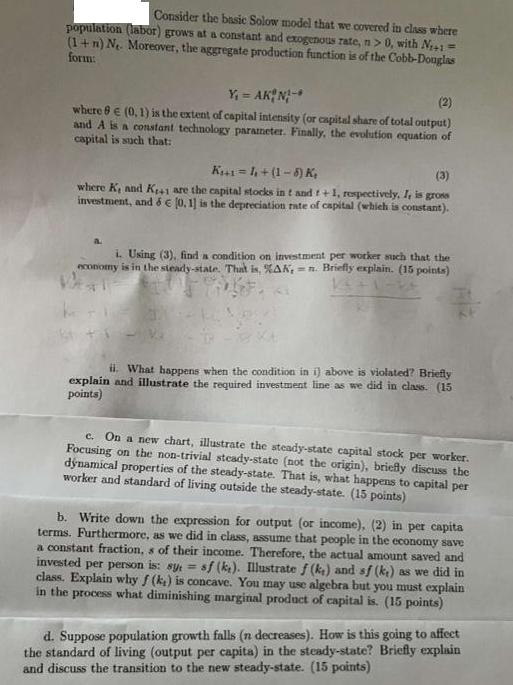
Consider the basic Solow model that we covered in class where population (labor) grows at a constant and exogenous rate, n > 0, with N+1 (1+n) N. Moreover, the aggregate production function is of the Cobb-Douglas form: Y = AKIN- (2) where 8 (0, 1) is the extent of capital intensity (or capital share of total output) and A is a constant technology parameter. Finally, the evolution equation of capital is such that: K1=1+(1-5) K, (3) where K, and K+1 are the capital stocks in t and t +1, respectively, I, is gross investment, and 6 [0, 1] is the depreciation rate of capital (which is constant). i. Using (3), find a condition on investment per worker such that the economy is in the steady-state. That is, %AK,=n. Briefly explain. (15 points) V** k ii. What happens when the condition in i) above is violated? Briefly explain and illustrate the required investment line as we did in class. (15 points) c. On a new chart, illustrate the steady-state capital stock per worker. Focusing on the non-trivial steady-state (not the origin), briefly discuss the dynamical properties of the steady-state. That is, what happens to capital per worker and standard of living outside the steady-state. (15 points) b. Write down the expression for output (or income), (2) in per capita terms. Furthermore, as we did in class, assume that people in the economy save a constant fraction, s of their income. Therefore, the actual amount saved and invested per person is: syt = sf (k). Illustrate f (ke) and sf (k) as we did in class. Explain why f (k) is concave. You may use algebra but you must explain in the process what diminishing marginal product of capital is. (15 points) d. Suppose population growth falls (n decreases). How is this going to affect the standard of living (output per capita) in the steady-state? Briefly explain and discuss the transition to the new steady-state. (15 points)
Step by Step Solution
3.44 Rating (157 Votes )
There are 3 Steps involved in it
To find the condition on investment per worker such that the economy is in the steadystate we can use equation 3 and set the change in capital stock p... View full answer

Get step-by-step solutions from verified subject matter experts
 Study Help