







Question: Consider the basic, two period, search model we discussed in class. We focus on the decisions of a marker that nds himself unemployed at the
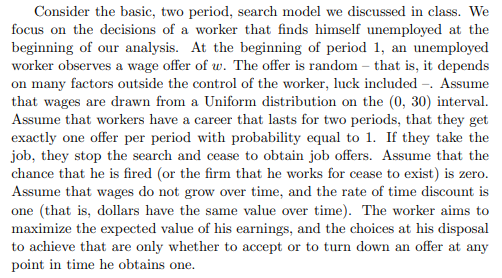
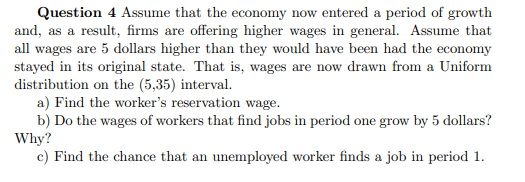
Consider the basic, two period, search model we discussed in class. We focus on the decisions of a marker that nds himself unemployed at the beginning of our analysis. At the beginning of period 1, an unemployed worker observes a wage offer of w. The oer is random that is, it depends on many factors outside the control of the worker, luck included . Assume that wages are drawn from a Uniform distribution on the [I], 3H} interval. Assume that mrkers have a career that lasts for two periods, that they get exactly one offer per period with probability equal to 1. If they take the job, they stop the search and cease to obtain job offers. Assume that the chance that he is red [or the rm that he 1:maorks for cease to exist} is zero. Assume that wages do not grow over time, and the rate of time discount is one {that is, dollars have the same value over time). The worker aims to maximise the expected value of his earnings, and the choicm at his disposal to achieve that are only whether to accept or to turn down an offer at any point in time he obtains one. Question 4 Assume that the economy now entered a period of growth and, as a result, firms are offering higher wages in general. Assume that all wages are 5 dollars higher than they would have been had the economy stayed in its original state. That is, wages are now drawn from a Uniform distribution on the (5,35) interval. a) Find the worker's reservation wage. b) Do the wages of workers that find jobs in period one grow by 5 dollars? Why? c) Find the chance that an unemployed worker finds a job in period 1
Step by Step Solution
There are 3 Steps involved in it

Get step-by-step solutions from verified subject matter experts
 Study Help