







Question: Consider the Bayesian network shown below. A.)Apply variable elimination to compute the marginal probabilities of: (1) Variable F: p(F) (2) Variable G: p(G) (3) The
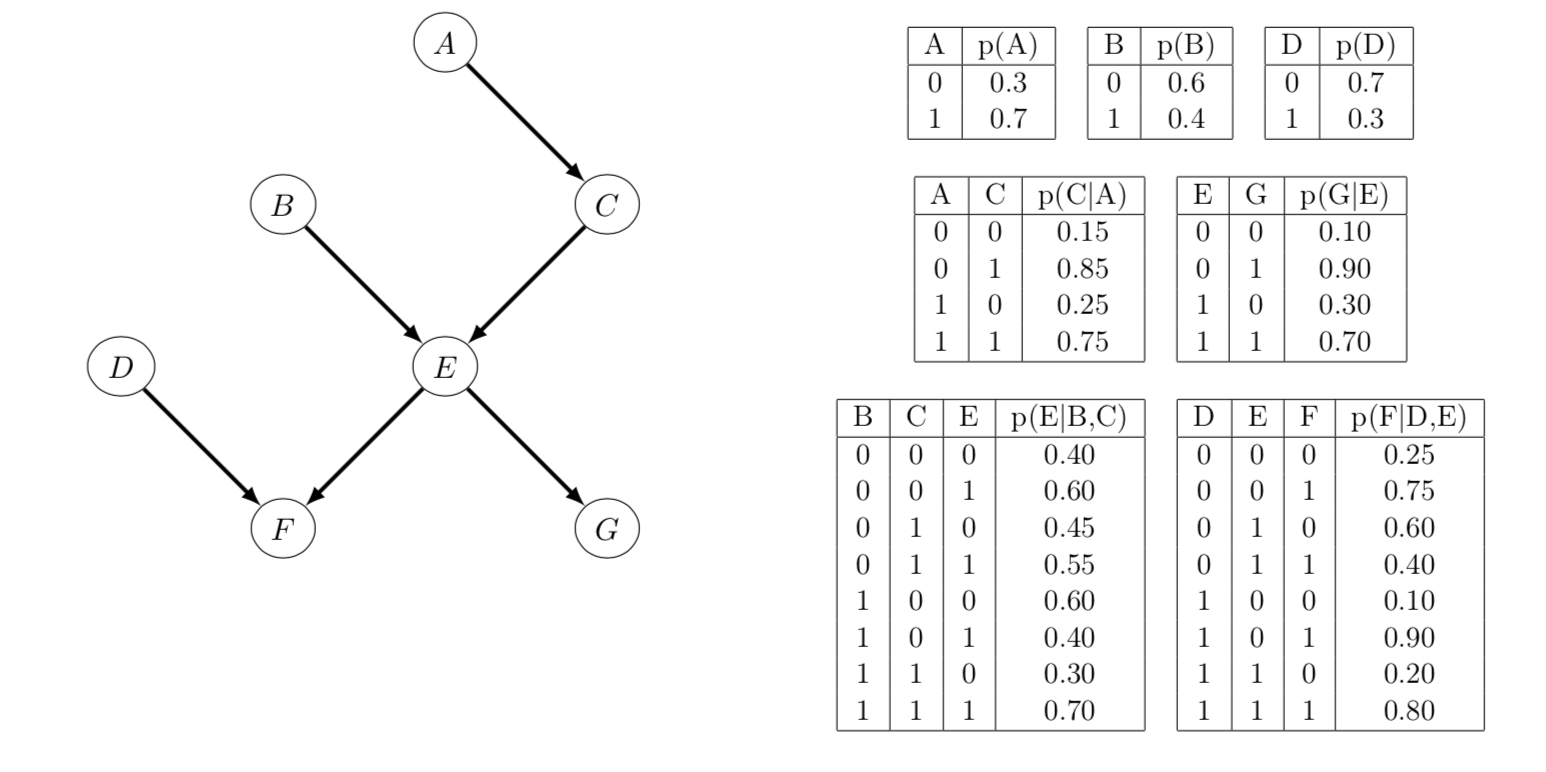
Consider the Bayesian network shown below.
A.)Apply variable elimination to compute the marginal probabilities of:
- (1) Variable F: p(F)
- (2) Variable G: p(G)
- (3) The variables C and G jointly: p(C, G).
For each part, report the elimination order used, along with the schematic computation of each bucket (e.g., which functions are collected together at each step, what function is produced, and their scopes). Also, what is the largest scope of any of the produced functions (the "induced width" of the computation)? You may use pyGM or any other software tool to perform the actual calculations, or do them manually if you prefer.
B.)Suppose that we observe evidence D = 0, C = 1. Apply variable elimination to compute the probability of the evidence, p(D = 0, C = 1). Again, report the operations performed as well as the result. What is the largest function constructed in performing this computation? (Note: it should be more efficient than directly computing the marginal probability over (C,D) for all values of C, D.)
C.)Apply max variable elimination to find the most probable configuration of the variables given evidence F = 0. What is the most likely configuration? Again, what was the largest function constructed?
\f
Step by Step Solution
There are 3 Steps involved in it

Get step-by-step solutions from verified subject matter experts
 Study Help