







Question: Consider the Bernoulli regression model, exiB P(yi = 1) = Pi = 1 + exiB' yi E {0, 1}, i = 1, ..., n, with
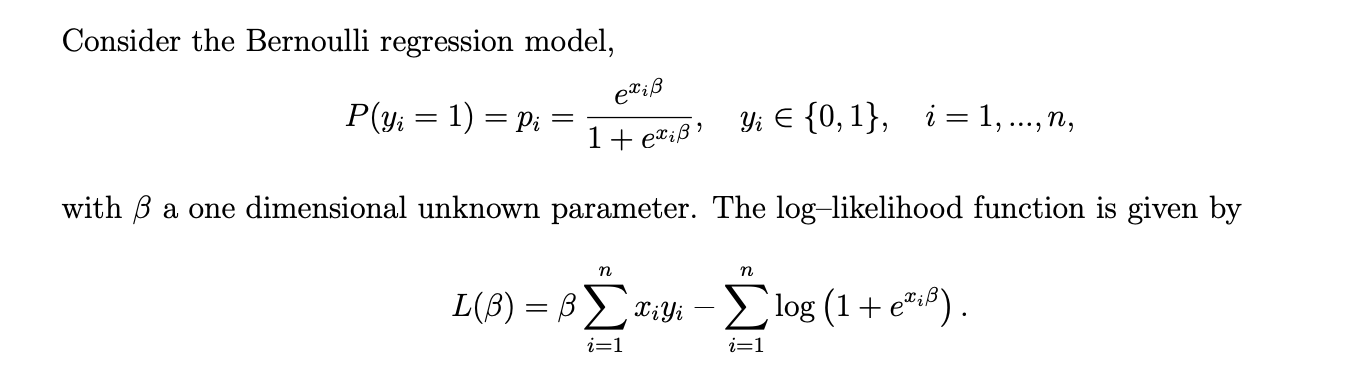
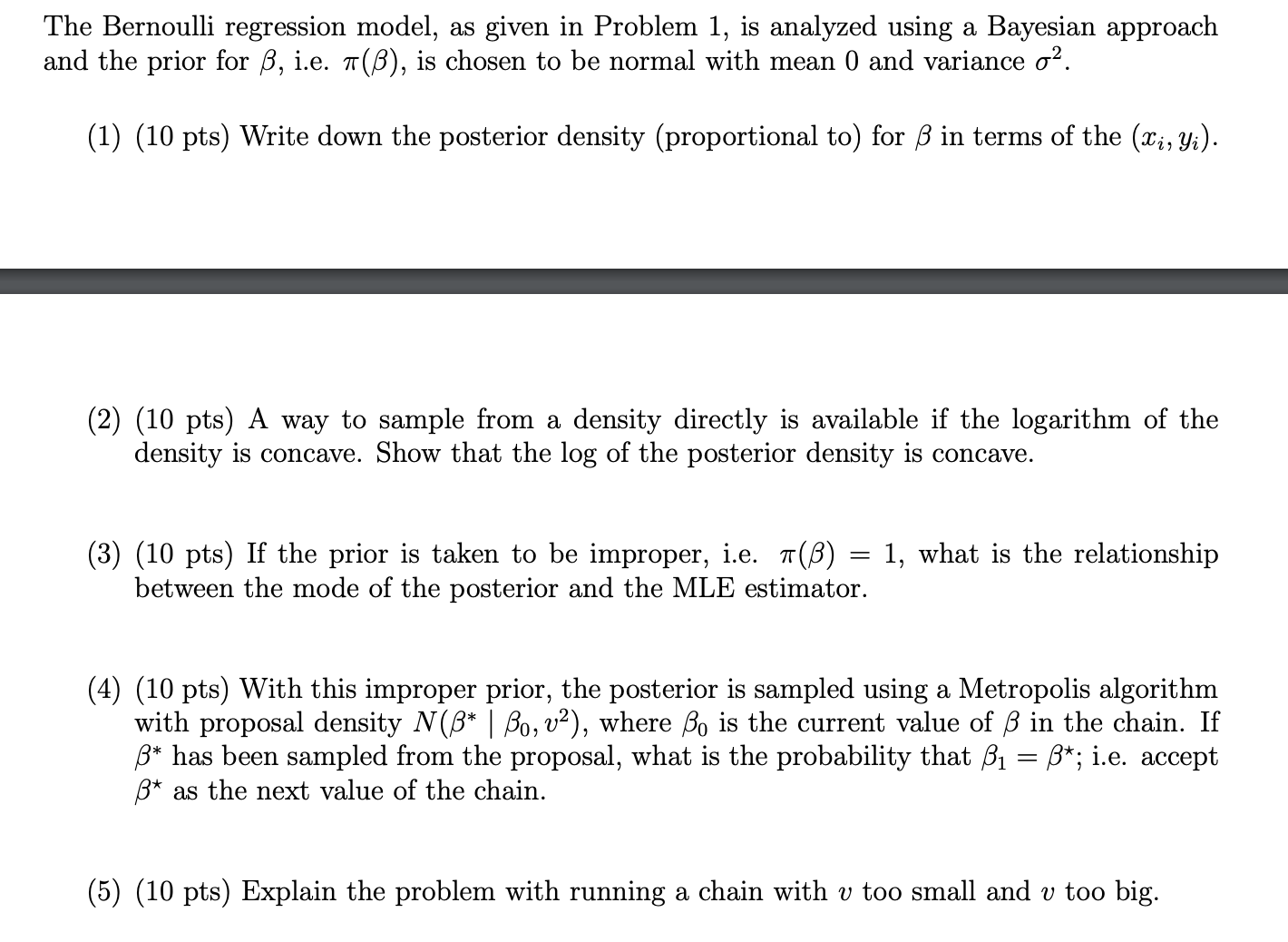
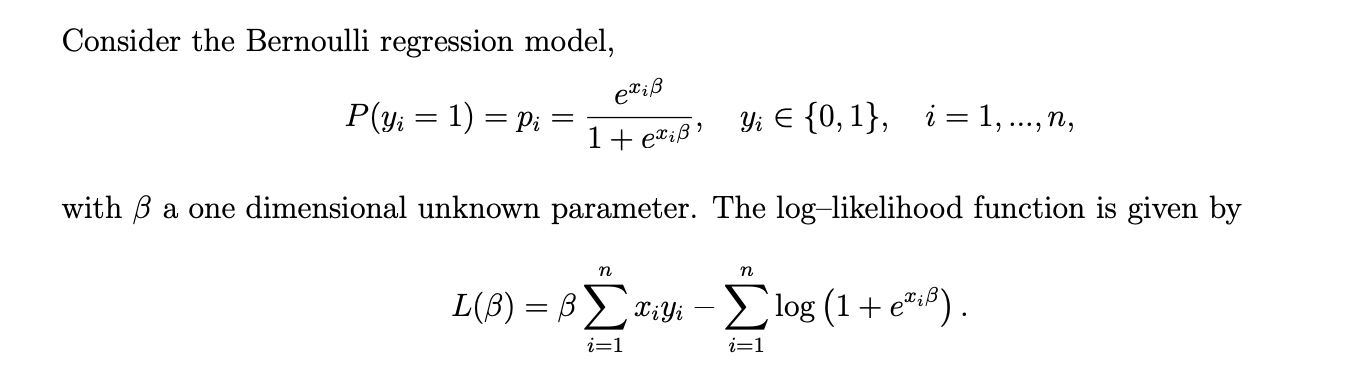
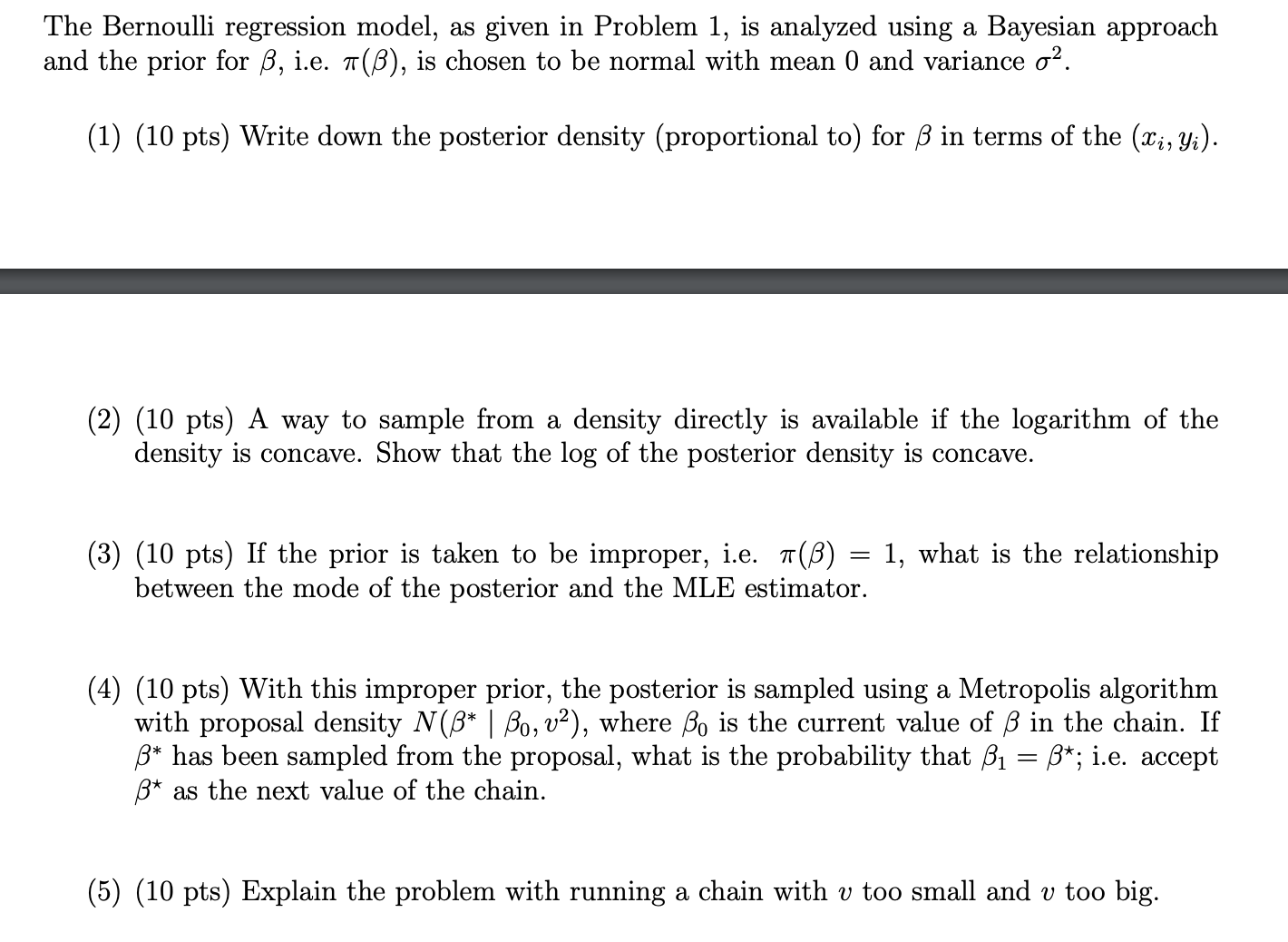
Consider the Bernoulli regression model, exiB P(yi = 1) = Pi = 1 + exiB' yi E {0, 1}, i = 1, ..., n, with S a one dimensional unknown parameter. The log-likelihood function is given by n n L( B ) = B Ciyi log (1 + exiB ) i=1 i=1The Bernoulli regression model, as given in Problem 1, is analyzed using a Bayesian approach and the prior for 6, i.e. (6), is chosen to be normal with mean 0 and variance a2. (1) (10 pts) Write down the posterior density (proportional to) for [3 in terms of the (sci, 3,25). (2) (10 pts) A way to sample from a density directly is available if the logarithm of the density is concave. Show that the log of the posterior density is concave. (3) (10 pts) If the prior is taken to be improper, i.e. (3) = 1, what is the relationship between the mode of the posterior and the MLE estimator. (4) (10 pts) With this improper prior, the posterior is sampled using a Metropolis algorithm with proposal density N(* | 30,112), where ,80 is the current value of ,8 in the chain. If 3* has been sampled from the proposal, what is the probability that 51 = 6*; i.e. accept 6* as the next value of the chain. (5) (10 pts) Explain the problem with running a chain with '0 too small and '0 too big
Step by Step Solution
There are 3 Steps involved in it

Get step-by-step solutions from verified subject matter experts
 Study Help