







Question: Consider the binary exponentiation algorithm: x and e are the inputs such that x is a real number; e is a positive, nonzero n-bit integer;
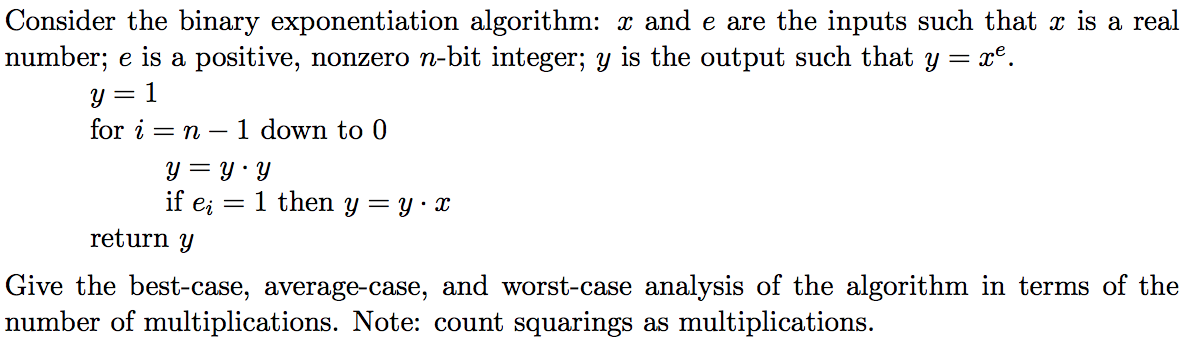
Consider the binary exponentiation algorithm: x and e are the inputs such that x is a real number; e is a positive, nonzero n-bit integer; y is the output such that y = x y=1 for i = n - 1 down to 0 y = y. y if e; = 1 then y=y. return y Give the best-case, average-case, and worst-case analysis of the algorithm in terms of the number of multiplications. Note: count squarings as multiplications
Step by Step Solution
There are 3 Steps involved in it
1 Expert Approved Answer
Step: 1 Unlock

Question Has Been Solved by an Expert!
Get step-by-step solutions from verified subject matter experts
Step: 2 Unlock
Step: 3 Unlock
 Study Help