







Question: Consider the C program below. (For space reasons, we are not checking error return codes, so assume that all functions return normally.) main() {
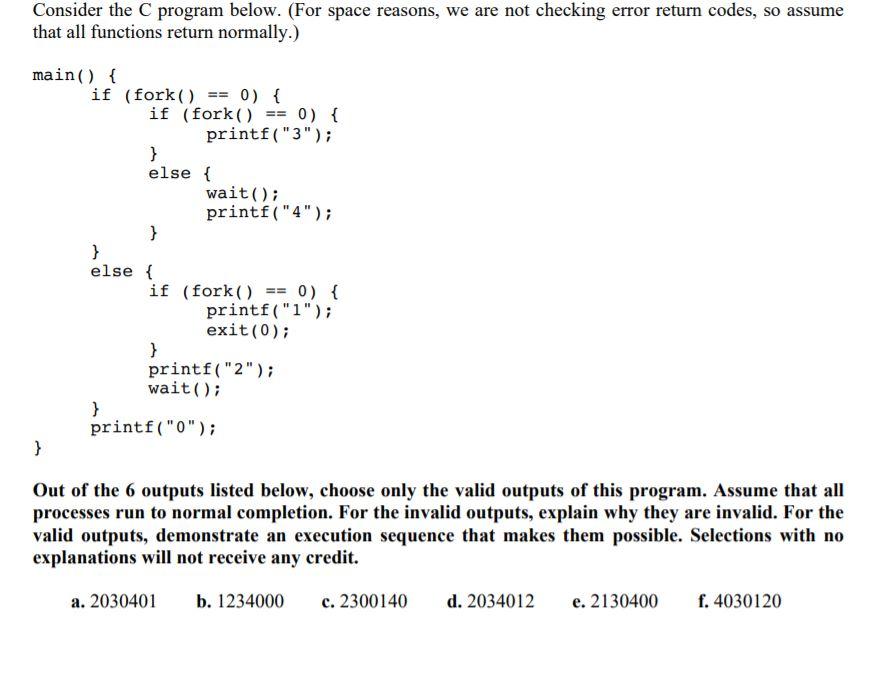
Consider the C program below. (For space reasons, we are not checking error return codes, so assume that all functions return normally.) main() { } if (fork() == 0) { if (fork() == 0) { printf("3"); } } else { } } else { wait(); printf("4"); if (fork() == 0) { printf("1"); exit(0); } printf("2"); wait (); printf("0"); Out of the 6 outputs listed below, choose only the valid outputs of this program. Assume that all processes run to normal completion. For the invalid outputs, explain why they are invalid. For the valid outputs, demonstrate an execution sequence that makes them possible. Selections with no explanations will not receive any credit. a. 2030401 b. 1234000 c. 2300140 d. 2034012 e. 2130400 f. 4030120
Step by Step Solution
There are 3 Steps involved in it
The image contains a C program that uses the fork system call to create child processes and then prints a sequence of numbers based on the return valu... View full answer

Get step-by-step solutions from verified subject matter experts
 Study Help