







Question: Consider the causal loop diagrams in chapter 5. For each, redraw the diagram showing the important stock and flow structure along with the feedback structure
Consider the causal loop diagrams in chapter 5. For each, redraw the diagram showing the important stock and flow structure along with the feedback structure shown in the diagram. In particular , identify the main stocks and flows in the fol lowing conceptualization case studies presented in chapter 5 :
Tools for Systems Thinking 1. The workload management example . 2. The oil industry and horse racing examples. 3. The traffic congestion example. In each case , consider whether the explicit representation of the main stocks and flows enhances your ability to understand the dynamics of the system or merely clutters the diagram
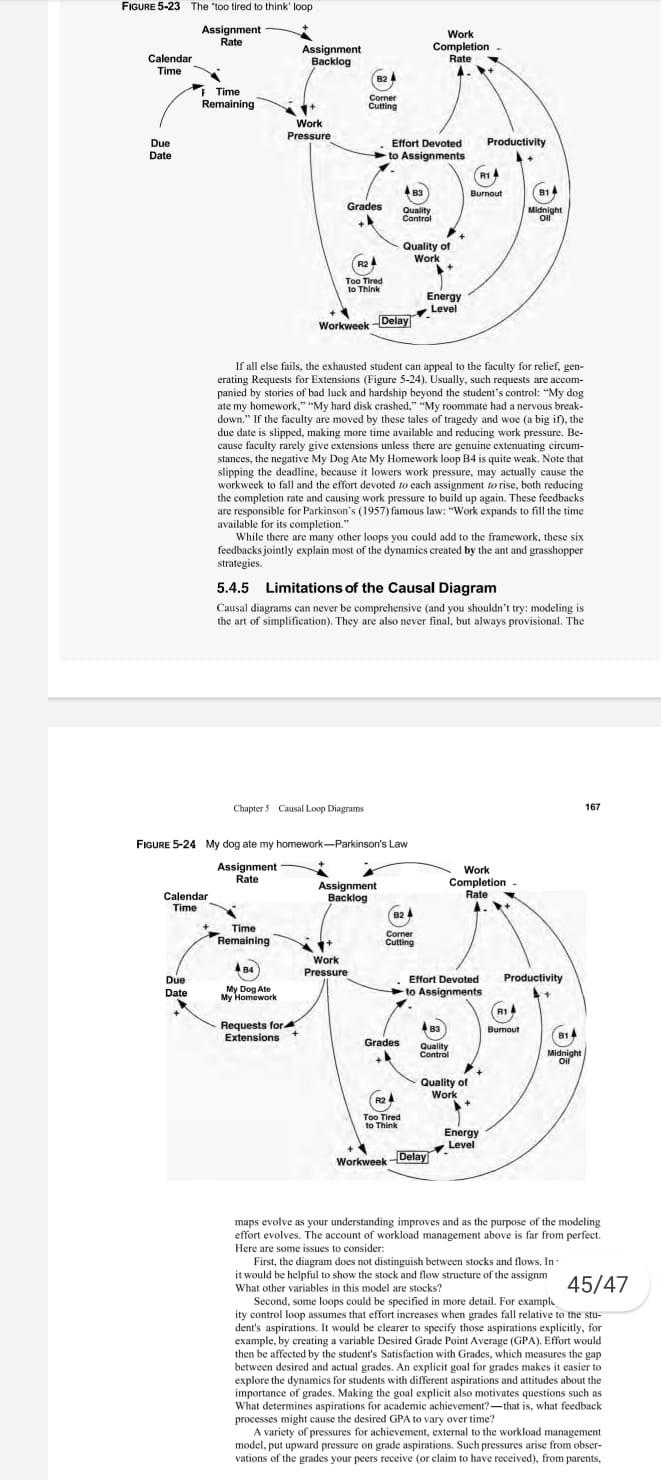
FIGURE 5-23 The "too tired to think loop Assignment Rate Work Completion Rate Assignment Backlog Calendar Time B2 Time Remaining Corner Cutting Work Pressure Due Date Effort Devoted Productivity to Assignments (A14 Burnout Grades 814 Midnight Ou Quality Control + Quality of Work R24 Too Tired to Think Energy Level Workweek Delay If all else fails, the exhausted student can appeal to the faculty for relief, gen- erating Requests for Extensions (Figure 5-24). Usually, such requests are accom- panied by stories of bad luck and hardship beyond the student's control: "My dog ate my homework." "My hard disk crashed." "My roommate had a nervous break- down." If the faculty are moved by these tales of tragedy and woe (a big if), the due date is slipped, making more time available and reducing work pressure. Be- cause faculty rarely give extensions unless there are genuine extenuating circum- stances, the negative My Dog Ate My Homework loop B4 is quite weak. Note that slipping the deadline, because it lowers work pressure, may actually cause the workweek to fall and the effort devoted to each assignment to rise, both reducing the completion rate and causing work pressure to build up again. These feedbacks are responsible for Parkinson's (1957) famous law: "Work expands to fill the time available for its completion." While there are many other loops you could add to the framework, these six feedbacks jointly explain most of the dynamics created by the ant and grasshopper strategies. 5.4.5 Limitations of the Causal Diagram Causal diagrams can never be comprehensive and you shouldn't try: modeling is the art of simplification). They are also never final, but always provisional. The Chapter 5 Causal Loop Diagrams 167 FIGURE 5-24 My dog ate my homework-Parkinson's Law Assignment Work Rate Assignment Completion Calendar Backlog Rate Time 32 Time Corner Remaining + Cutting Work Pressure Due Effort Devoted Productivity Date My Dog Ate to Assignments My Homework (R1 Requests for B3 Burnout (614 Grades Quality Control Midnight Oil Extensions + Quality of Work R2 Too Tired to Think Energy Level Workweek-Delay maps evolve as your understanding improves and as the purpose of the modeling effort evolves. The account of workload management above is far from perfect. Here are some issues to consider: First, the diagram does not distinguish between stocks and flows. In it would be helpful to show the stock and flow structure of the assignm What other variables in this model are stocks? 45/47 Second, some loops could be specified in more detail. For example ity control loop assumes that effort increases when grades fall relative to the stu- dent's aspirations. It would be clearer to specify those aspirations explicitly, for cxample, by creating a variable Desired Grade Point Average (GPA). Effort would then be affected by the student's Satisfaction with Grades, which measures the gap between desired and actual grades. An explicit goal for grades makes it easier to explore the dynamics for students with different aspirations and attitudes about the importance of grades. Making the goal explicit also motivates questions such as What determines aspirations for academic achievement? -- that is what feedback processes might cause the desired GPA to vary over time? A variety of pressures for achievement, external to the workload management model, put upward pressure on grade aspirations. Such pressures arise from obser- vations of the grades your peers receive (or claim to have received), from parents
Step by Step Solution
There are 3 Steps involved in it
1 Expert Approved Answer
Step: 1 Unlock

Question Has Been Solved by an Expert!
Get step-by-step solutions from verified subject matter experts
Step: 2 Unlock
Step: 3 Unlock
 Study Help