







Question: Consider the data in the table collected from four independent populations. Sample Sample Sample Sample 1 2 3 4 20 14 22 18 a) Calculate
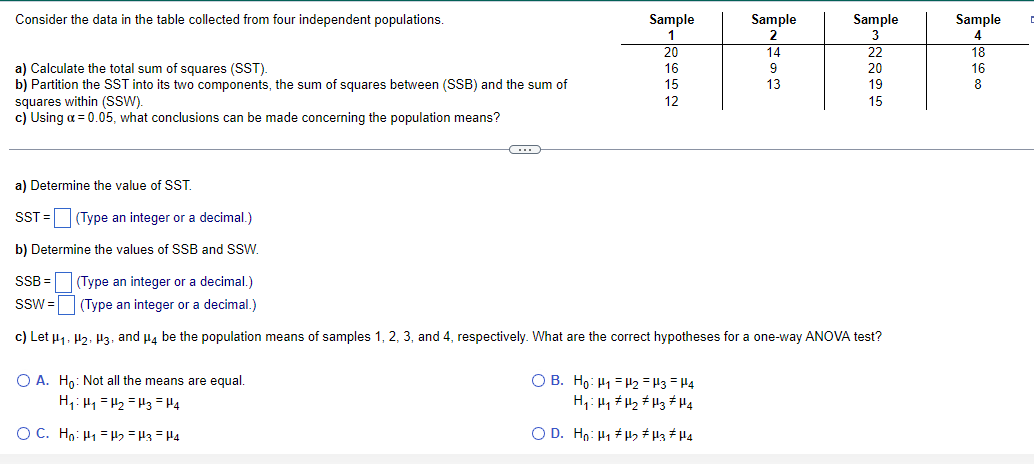
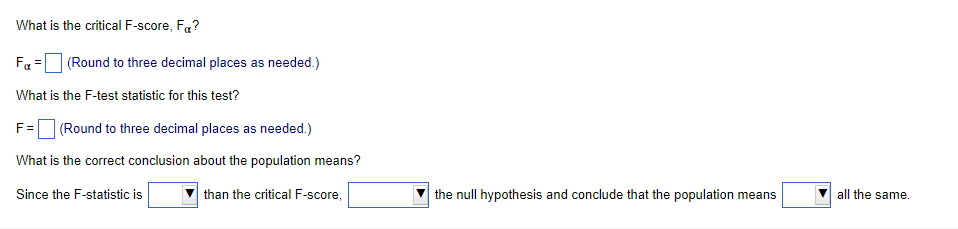
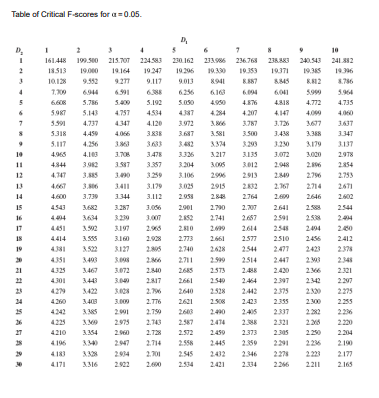
Consider the data in the table collected from four independent populations. Sample Sample Sample Sample 1 2 3 4 20 14 22 18 a) Calculate the total sum of squares (SST). 16 9 20 16 b) Partition the SST into its two components, the sum of squares between (SSB) and the sum of 15 13 19 8 squares within (SSW). 12 15 c) Using a = 0.05, what conclusions can be made concerning the population means? a) Determine the value of SST. SST = (Type an integer or a decimal.) b) Determine the values of SSB and SSW. SSB = (Type an integer or a decimal.) SSW = (Type an integer or a decimal.) c) Let Hy, H2. H3, and u4 be the population means of samples 1, 2, 3, and 4, respectively. What are the correct hypotheses for a one-way ANOVA test? O A. Ho: Not all the means are equal. OB. Ho: H1 = H2 = M3 = H4 Hy : Hy = H2 = 13 = H4 Hy : My # 12 # H3 * H4 O C. Ho: H1 = H> = Ha = H4 OD. Ho: H1 # H> # Ha # H4What is the critical F-score, Fa? For = (Round to three decimal places as needed.) What is the F-test statistic for this test? F= (Round to three decimal places as needed.) What is the correct conclusion about the population means? Since the F-statistic is than the critical F-score, the null hypothesis and conclude that the population means all the same.\f
Step by Step Solution
There are 3 Steps involved in it

Get step-by-step solutions from verified subject matter experts
 Study Help