







Question: 1.6 52 1.667 64 1.7 59 1.733 54 1.75 47 1.75 54 1.75 58 1.75 47 1.75 48 1.75 62 There is more values of
| 1.6 | 52 |
| 1.667 | 64 |
| 1.7 | 59 |
| 1.733 | 54 |
| 1.75 | 47 |
| 1.75 | 54 |
| 1.75 | 58 |
| 1.75 | 47 |
| 1.75 | 48 |
| 1.75 | 62 |
There is more values of the data that i have but i am mostly looking for an example of how to answer these questions with any data. The script and method example would be very helpful.
Y was formed from:
Define a centering matrix in Matlab, and call it 'C'. Use the centering matrix 'C' to help create a new matrix 'Y', where 'Y' contains the data points from 'X', but with the mean subtracted from each feature (i.e., dimension, column) of X.
C = eye-(1/n)*ones;
Y = C * X;
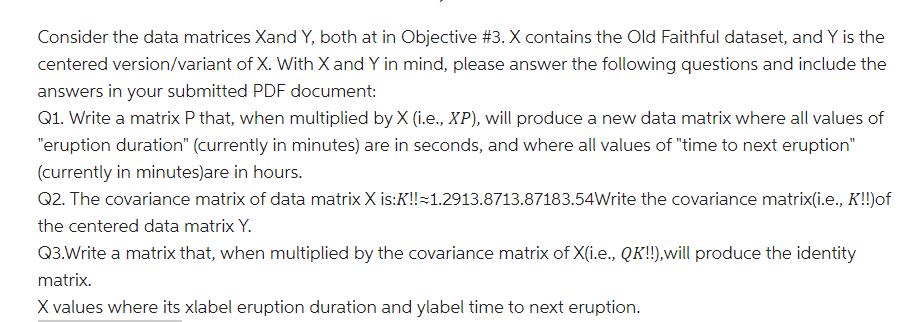
Consider the data matrices Xand Y, both at in Objective #3. X contains the Old Faithful dataset, and Y is the centered version/variant of X. With X and Y in mind, please answer the following questions and include the answers in your submitted PDF document: Q1. Write a matrix P that, when multiplied by X (i.e., XP), will produce a new data matrix where all values of "eruption duration" (currently in minutes) are in seconds, and where all values of "time to next eruption" (currently in minutes)are in hours. Q2. The covariance matrix of data matrix X is:K!!~1.2913.8713.87183.54Write the covariance matrix(i.e., K!!)of the centered data matrix Y. Q3.Write a matrix that, when multiplied by the covariance matrix of X(i.e., QK!!),will produce the identity matrix. X values where its xlabel eruption duration and ylabel time to next eruption.
Step by Step Solution
3.34 Rating (145 Votes )
There are 3 Steps involved in it
Q1 The matrix P that can be used to convert the eruption duration into seconds and time to next erup... View full answer

Get step-by-step solutions from verified subject matter experts
 Study Help