







Question: Consider the database table structure shown in the figure. (a) Write a SELECT statement (compatible with an Oracle RDBMS) that returns three columns from the
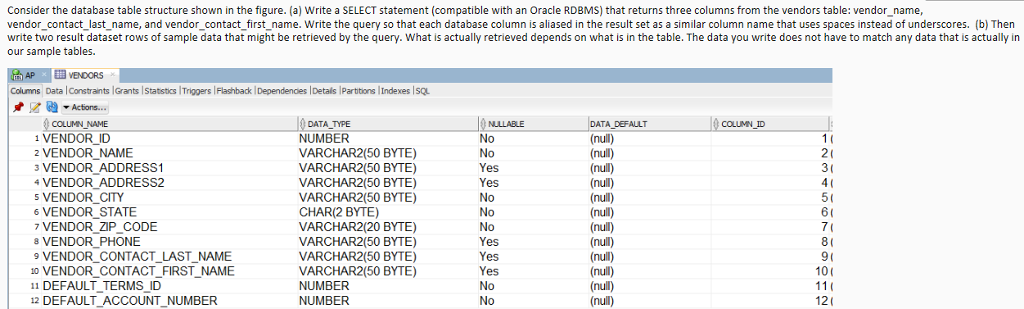
Consider the database table structure shown in the figure. (a) Write a SELECT statement (compatible with an Oracle RDBMS) that returns three columns from the vendors table: vendor_name, vendor_contact last_name, and vendor_contact first_name. Write the query so that each database column is aliased in the result set as a similar column name that uses spaces instead of underscores. (b) Then write two result dataset rows of sample data that might be retrieved by the query. What is actually retrieved depends on what is in the table. The data you write does not have to match any data that is actually in our sample tables. AP Columns Data lConstraints lGrants IStatstics ITriggers Flashback IDependendes IDetals Parttions Indexes Isqu COLUMN NAME DATA TYPE NUMBER VARCHAR2(50 BYTE) VARCHAR2(50 BYTE) VARCHAR2(50 BYTE) VARCHAR2(50 BYTE) CHAR(2 BYTE) VARCHAR2(20 BYTE) VARCHAR2(50 BYTE) VARCHAR2(50 BYTE) VARCHAR2(50 BYTE) NUMBER NUMBER DATA DEFAULT (null) (null) (null) (nul) (null) (null) (null) (nul) (null) (null) (null) (null) NULLABLE COLUMN ID VENDOR ID 2 VENDOR NAME 3 VENDOR ADDRESS1 VENDOR ADDRESS2 VENDOR CITY 6 VENDOR STATE VENDOR ZP_CODE 8 VENDOR PHONE VENDOR CONTACT LAST NAME 0 No Yes Yes 20 3 ( No Yes es es No No 5 0 6 0 7 8 0 9 0 100 0 VENDOR CONTACT FIRST NAME DEFAULT TERMS ID 2 DEFAULT ACCOUNT NUMBER 12
Step by Step Solution
There are 3 Steps involved in it

Get step-by-step solutions from verified subject matter experts
 Study Help