







Question: Consider the dataset training data shown in Table 1. The data consists of clinical features (i.e., four features) for several patients, relating several conditions with
Consider the dataset training data shown in Table 1. The data consists of clinical features (i.e., four features) for several patients, relating several conditions with the existence of the coronary disease. Using the data in Table 1, determine the parameters of a Nave Bayes classifier. Indicate the most relevant calculations.
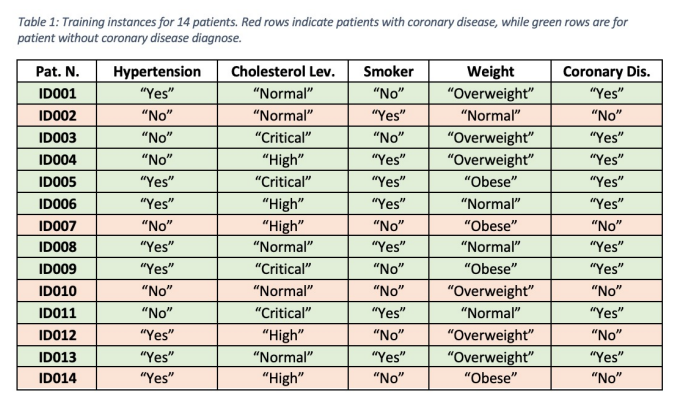
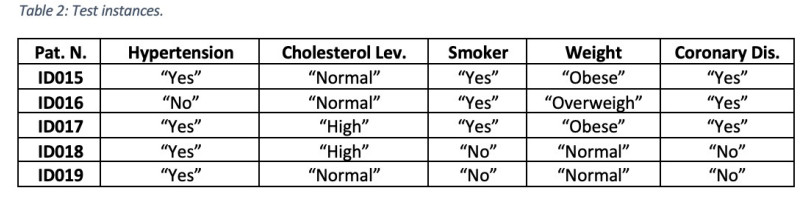
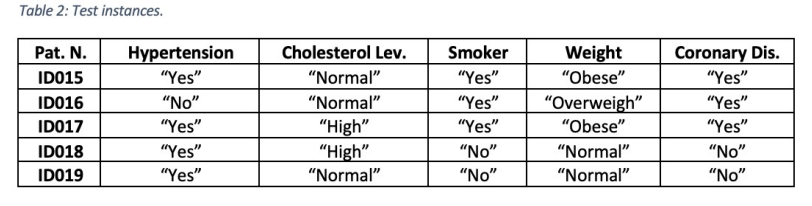
Table 1: Training instances for 14 patients. Red rows indicate patients with coronary disease, while green rows are for patient without coronary disease diagnose. Pat. N. Hypertension Cholesterol Lev. Smoker Weight Coronary Dis. IDO01 "Yes" "Normal" "NO" "Overweight" "Yes" IDO02 "No" "Normal" "Yes" "Normal" "No" IDO03 "No" "Critical" "No" "Overweight" "Yes" ID004 "No" "High" "Yes" "Overweight" "Yes" IDOOS "Yes" "Critical" "Yes" "Obese" "Yes" ID006 "Yes" "High" "Yes" "Normal" Yes" ID007 "No" "High" "NO" "Obese" "No" IDO08 "Yes" "Normal" "Yes" "Normal" "Yes" ID009 "Yes" "Critical" "No" "Obese" "Yes" IDO10 "No" "Normal" "No" "Overweight" "No" IDO11 "No" "Critical" "Yes" "Normal" "Yes" IDO12 "Yes" "High" "No" "Overweight" "No" ID013 "Yes" "Normal" "Yes" "Overweight" "Yes" IDO14 "Yes" "High" "No" "Obese" "No"Table 2: Test instances. Pat. N. Hypertension Cholesterol Lev. Smoker Weight Coronary Dis. IDO15 "Yes" "Normal" "Yes" "Obese" "Yes" ID016 "No" "Normal" "Yes" "Overweigh" "Yes" ID017 "Yes" "High" "Yes" "Obese" "Yes" IDO18 "Yes" "High" "No" "Normal" "No" ID019 "Yes" "Normal" "No" "Normal" "No"
Step by Step Solution
There are 3 Steps involved in it

Get step-by-step solutions from verified subject matter experts
 Study Help