







Question: Consider the diet problem summarized in the following table. In this table, different food items available in a Mac Donalds restaurant are displayed in column
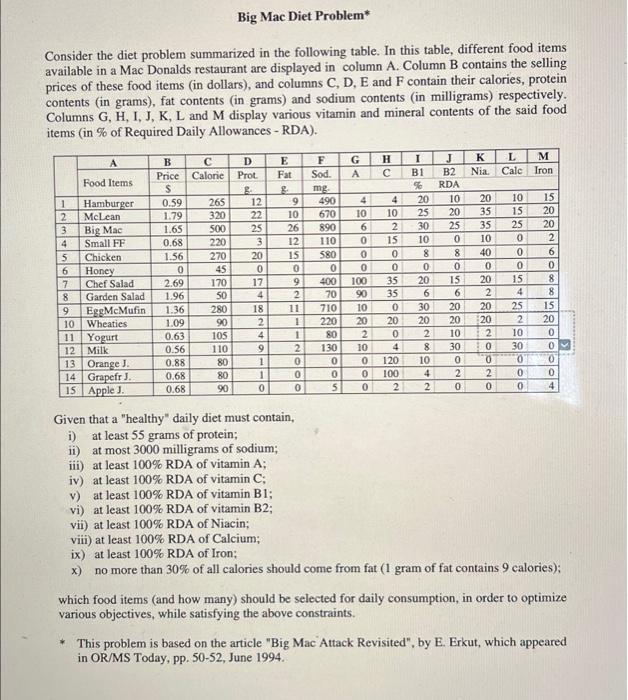

Consider the diet problem summarized in the following table. In this table, different food items available in a Mac Donalds restaurant are displayed in column A. Column B contains the selling prices of these food items (in dollars), and columns C, D, E and F contain their calories, protein contents (in grams), fat contents (in grams) and sodium contents (in milligrams) respectively. Columns G, H, I, J, K, L and M display various vitamin and mineral contents of the said food items (in % of Required Daily Allowances - RDA). Given that a "healthy" daily diet must contain, i) at least 55 grams of protein; ii) at most 3000 milligrams of sodium; iii) at least 100% RDA of vitamin A; iv) at least 100% RDA of vitamin C; v) at least 100% RDA of vitamin B1; vi) at least 100% RDA of vitamin B2; vii) at least 100% RDA of Niacin; viii) at least 100% RDA of Calcium; ix) at least 100% RDA of Iron; x) no more than 30% of all calories should come from fat (1 gram of fat contains 9 calories); which food items (and how many) should be selected for daily consumption, in order to optimize various objectives, while satisfying the above constraints. * This problem is based on the article "Big Mac Attack Revisited", by E. Erkut, which appeared in OR/MS Today, pp. 50-52, June 1994. Construct and solve L.P. models to minimize and maximize total daily cost. In the maximization case, comment on reasons of and ways to avoid unboundedness. Comment on the range defined by the minimum and maximum costs
Step by Step Solution
There are 3 Steps involved in it

Get step-by-step solutions from verified subject matter experts
 Study Help