







Question: Consider the difference equation p(n) = p(n-1) + 100 p(n-1)-X Where p(n) is the principal owed at time nT, T is one payment period r
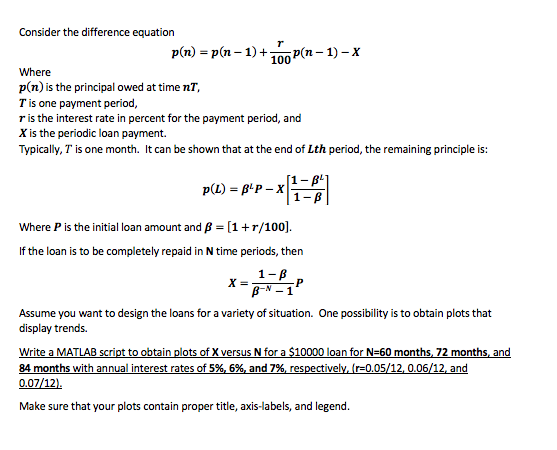
Consider the difference equation p(n) = p(n-1) + 100 p(n-1)-X Where p(n) is the principal owed at time nT, T is one payment period r is the interest rate in percent for the payment period, and X is the periodic loan payment. Typically, T is one month. It can be shown that at the end of Lth period, the remaining principle is: where P is the initial loan amount and ?-[1 + r/100]. If the loan is to be completely repaid in N time periods, then Assume you want to design the loans for a variety of situation. One possibility is to obtain plots that display trends. MAT X versus N f loan for N-60 mont months, and 84 months with annual interest rates 0.07/12. Make sure that your plots contain proper title, axis-labels, and legend. 6%, and 7%, res Consider the difference equation p(n) = p(n-1) + 100 p(n-1)-X Where p(n) is the principal owed at time nT, T is one payment period r is the interest rate in percent for the payment period, and X is the periodic loan payment. Typically, T is one month. It can be shown that at the end of Lth period, the remaining principle is: where P is the initial loan amount and ?-[1 + r/100]. If the loan is to be completely repaid in N time periods, then Assume you want to design the loans for a variety of situation. One possibility is to obtain plots that display trends. MAT X versus N f loan for N-60 mont months, and 84 months with annual interest rates 0.07/12. Make sure that your plots contain proper title, axis-labels, and legend. 6%, and 7%, res
Step by Step Solution
There are 3 Steps involved in it

Get step-by-step solutions from verified subject matter experts
 Study Help