







Question: Consider the differential equation mx + cx + kx = f(t) describing the lumped parameter model shown below. describing the lumped parameter model shown below
Consider the differential equation
mx + cx + kx = f(t)
describing the lumped parameter model shown below.
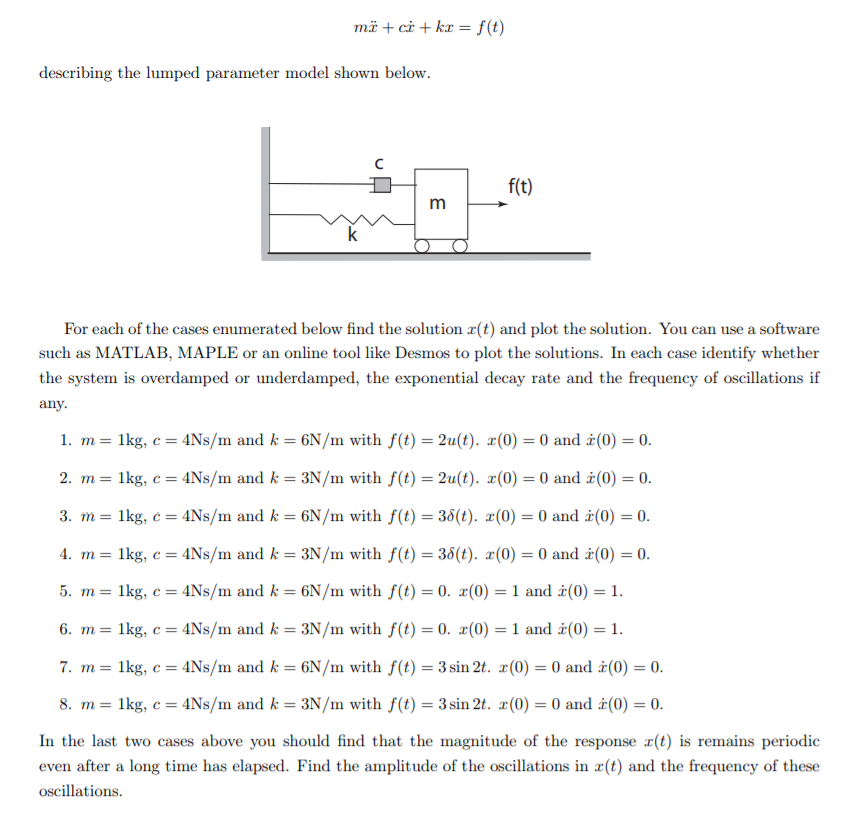
describing the lumped parameter model shown below f(t) For each of the cases enumerated below find the solution r(t) and plot the solution. You can use a software such as MATLAB, MAPLE or an online tool like Desmos to plot the solutions. In each case identify whether the system is overdamped or underdamped, the exponential decay rate and the frequency of oscillations if uuy 1. m lkg, c-4Ns/m and k 6N/m with f(t)-2u(t). (0) nd (0)0 2. m 1kg, c = 4Ns/m and k 2N/m with f(t) = 2a(t). 2(0) = 0 and x(0) = 0 3. m-lkg, c 4Ns/m and k 6N/m with f(t)-3(t). (00 and (00 4. m- lkg, c-4Ns/m and k 3N/m with f(t) 38(t). (00 and (0. 5. m- lkg, c4Ns/m and k 6N/m with f(t)-0. x(0) 1 and (0)1 6. m 1kg, c = 4Ns/m and k 2N/m with f(t) =0. 2(0) = 1 and x(0)-1 7. m- lkg,c 4Ns/m and k 6N/m with f(t) 3sin 2t. r(0) 0 and (0 8. m lkg,c 4Ns/m and k 3N/m with f(t) 3sin 2t. r(0) 0 and (0 In the last two cases above you should find that the magnitude of the response a(t) is remains periodic even after a long time has elapsed. Find the amplitude of the oscillations in a(t) and the frequency of these oscillations
Step by Step Solution
There are 3 Steps involved in it

Get step-by-step solutions from verified subject matter experts
 Study Help