







Question: Consider the Ethernet LAN with three users as shown in the figure below: Ethernet Shared Medium UI | Prop del=t/2 | U2 | Prop del=t/2
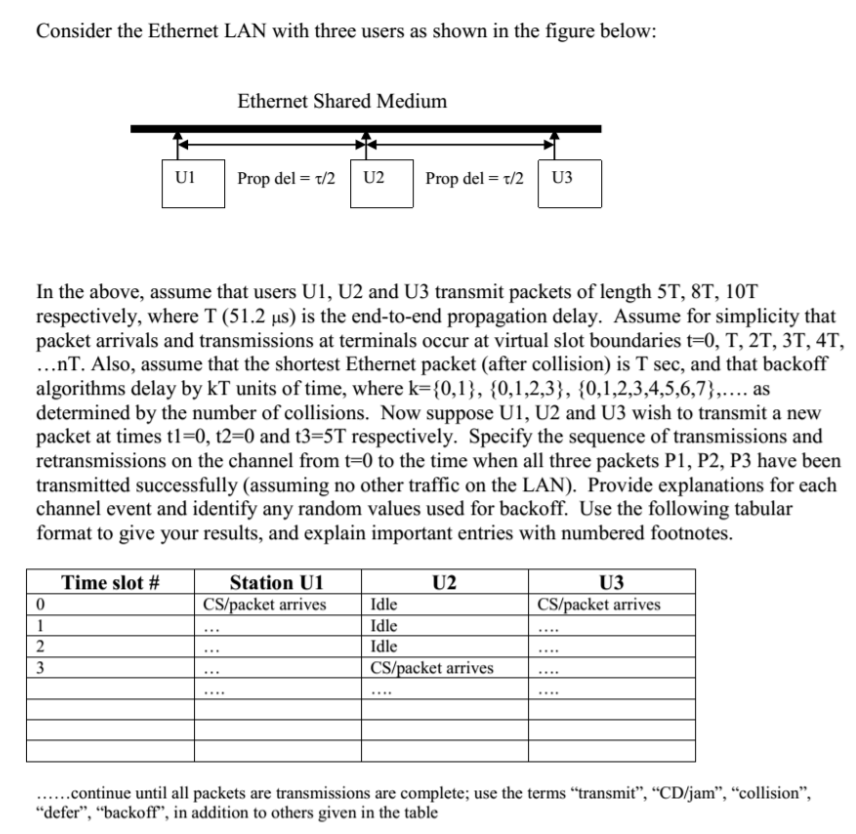
Consider the Ethernet LAN with three users as shown in the figure below: Ethernet Shared Medium UI | Prop del=t/2 | U2 | Prop del=t/2 | U3 In the above, assume that users U1, U2 and U3 transmit packets of length 5T, 8T, 1OT respectively, where T (51.2 us) is the end-to-end propagation delay. Assume for simplicity that packet arrivals and transmissions at terminals occur at virtual slot boundaries t-0, T, 2T, 3T, 4T, ...nT. Also, assume that the shortest Ethernet packet (after collision) is T sec, and that backoff algorithms delay by kT units of time, where k-10,1;, {0,1,2,3;, (0,1,2,3,4,5,6,7;,... as determined by the number of collisions. Now suppose U1, U2 and U3 wish to transmit a new packet at times tl-0, t2-0 and t3-5T respectively. Specify the sequence of transmissions and retransmissions on the channel from t-0 to the time when all three packets P1, P2, P3 have been transmitted successfully (assuming no other traffic on the LAN). Provide explanations for each channel event and identify any random values used for backoff. Use the following tabular format to give your results, and explain important entries with numbered footnotes Time slot # 0 Station Ul CS/packet arrives U2 U3 CS/packet arrives Idle Idle CS/packet arrives continue until all packets are transmissions are complete; use the terms "transmit, CD/jam, collision" "defer", "backoff", in addition to others given in the table
Step by Step Solution
There are 3 Steps involved in it

Get step-by-step solutions from verified subject matter experts
 Study Help