







Question: Consider the flooding algorithm in an arbitrary network G- (V, E): 1) Each node acts as both a transmitter and a receiver, and 2) Each
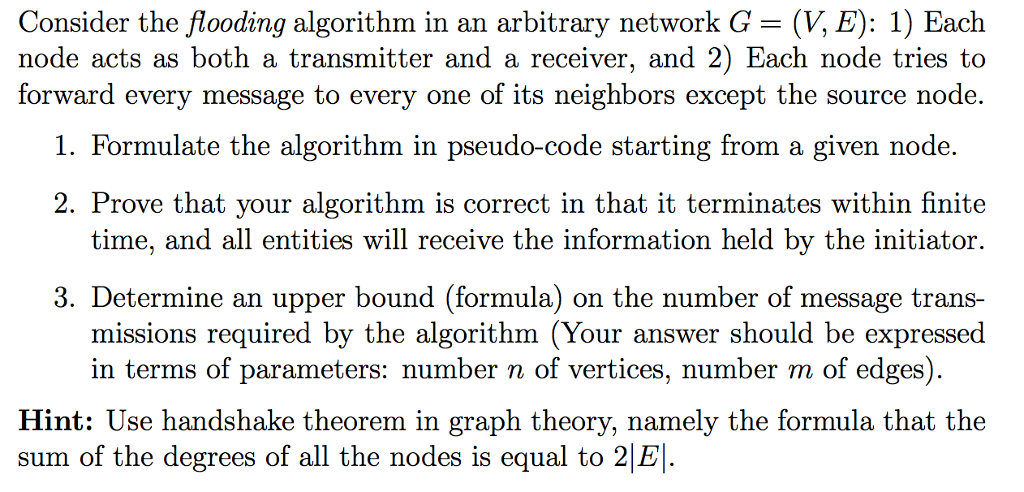
Consider the flooding algorithm in an arbitrary network G- (V, E): 1) Each node acts as both a transmitter and a receiver, and 2) Each node tries to torward every message to every one of its neighbors except the source node. 1. Formulate the algorithm in pseudo-code starting from a given node. 2. Prove that your algorithm is correct in that it terminates within finite time, and all entities will receive the information held by the initiator. 3. Determine an upper bound (formula) on the number of message trans- missions required by the algorithm (Your answer should be expressed in terms of parameters: number n of vertices, number m of edges) Hint: Use handshake theorem in graph theory, namely the formula that the sum of the degrees of all the nodes is equal to 2E Consider the flooding algorithm in an arbitrary network G- (V, E): 1) Each node acts as both a transmitter and a receiver, and 2) Each node tries to torward every message to every one of its neighbors except the source node. 1. Formulate the algorithm in pseudo-code starting from a given node. 2. Prove that your algorithm is correct in that it terminates within finite time, and all entities will receive the information held by the initiator. 3. Determine an upper bound (formula) on the number of message trans- missions required by the algorithm (Your answer should be expressed in terms of parameters: number n of vertices, number m of edges) Hint: Use handshake theorem in graph theory, namely the formula that the sum of the degrees of all the nodes is equal to 2E
Step by Step Solution
There are 3 Steps involved in it

Get step-by-step solutions from verified subject matter experts
 Study Help