







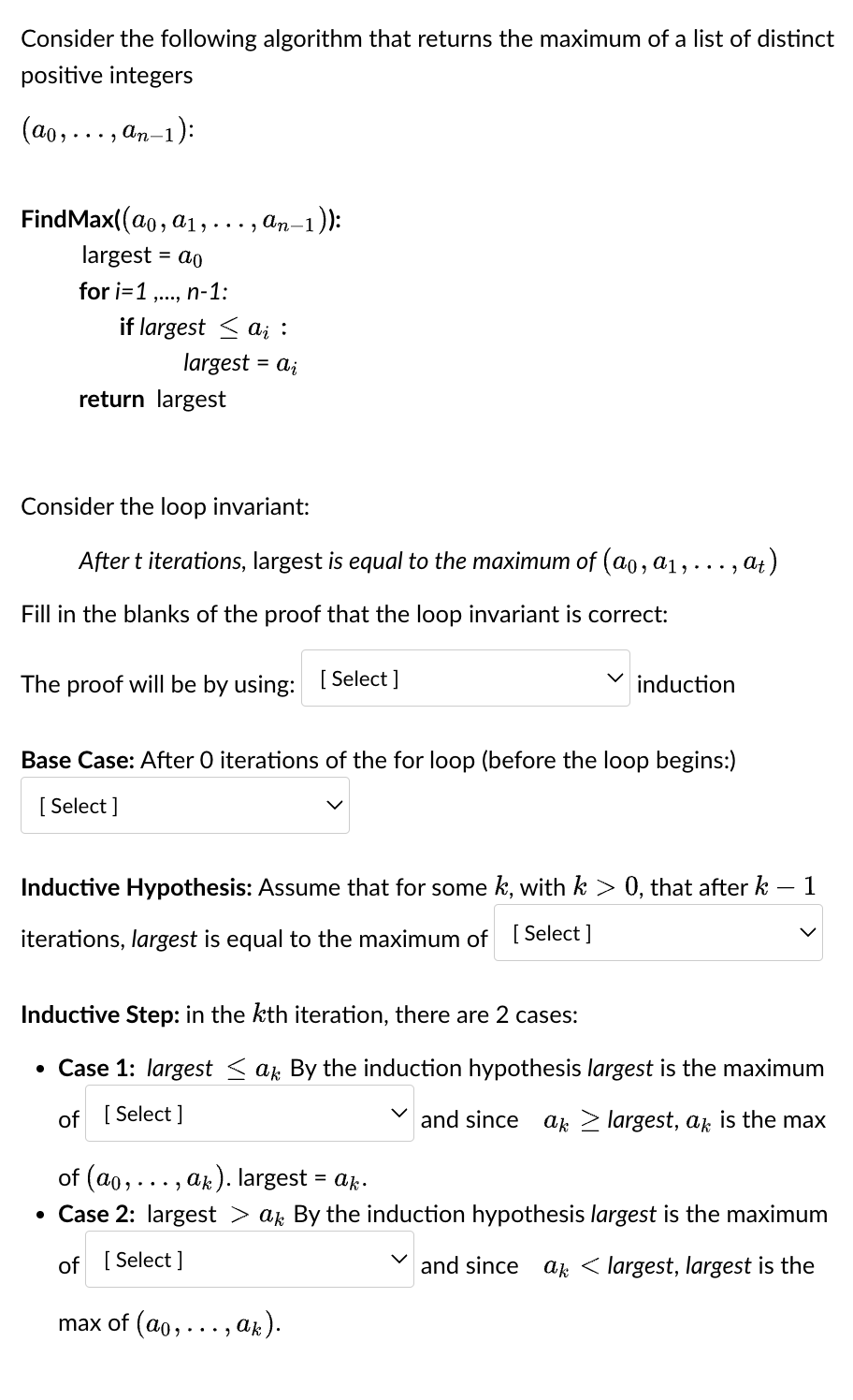
Question: Consider the following algorithm that returns the maximum of a list of distinct positive integers ( a 0 , . . . . , a
Consider the following algorithm that returns the maximum of a list of distinct positive integers
FindMaxaaan:
largest a
for i n:
if largest ai :
largest ai
return largest
Consider the loop invariant:
After iterations, largest is equal to the maximum of
Fill in the blanks of the proof t regularstronginduction
Base Case: After iterations of the for loop before the loop begins:largest is smaller than a largest is maximum of the empty list, largest is maximum of the list aa largest is maximum of the list a
Inductive Hypothesis: Assume that for some with that after iterations, largest is equal to the maximum of aakaakaakaak
Inductive Step: in the th iteration, there are cases:
Case : largest By the induction hypothesis largest is the maximum of aakaakaakaak
and since largest,
Case : largest By the induction hypothesis largest is the maximum of aakaakaakaak
and since largest, is the max of aak
Step by Step Solution
There are 3 Steps involved in it
1 Expert Approved Answer
Step: 1 Unlock

Question Has Been Solved by an Expert!
Get step-by-step solutions from verified subject matter experts
Step: 2 Unlock
Step: 3 Unlock
 Study Help