







Question: Consider the following algorithm to compute binomial coefficients. function C(n, k) if k = 0 or k = n then return 1 else return C(n
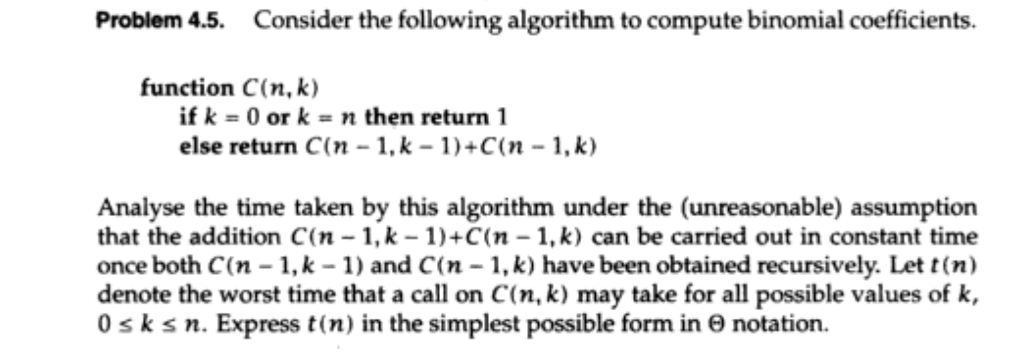
Consider the following algorithm to compute binomial coefficients. function C(n, k) if k = 0 or k = n then return 1 else return C(n - 1, k - 1)+C(n - 1, k) Analyse the time taken by this algorithm under the (unreasonable) assumption that the addition C(n -1, k-1)+C(n -1, k) can be carried out in constant time once both C(n - 1, k - 1) and C(n - 1, k) have been obtained recursively. Let t(n) denote the worst time that a call on C(n, k) may take for all possible values of k, 0 lessthanorequalto k lessthanorequalto t(n). Express t(n) in the simplest possible form in Theta notation
Step by Step Solution
There are 3 Steps involved in it
1 Expert Approved Answer
Step: 1 Unlock

Question Has Been Solved by an Expert!
Get step-by-step solutions from verified subject matter experts
Step: 2 Unlock
Step: 3 Unlock
 Study Help