





Question: Consider the following ambiguous BNF grammar: ? : | = && | || | ! | | true | false | () x | y

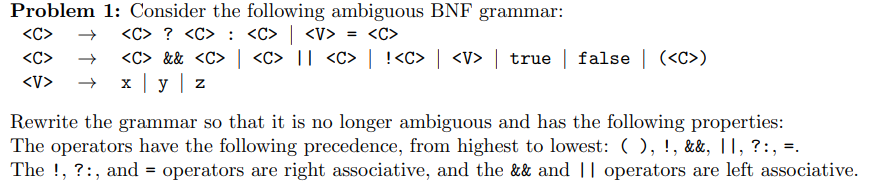
Consider the following ambiguous BNF grammar: ? : | = && | || | ! | | true | false | () x | y | z Rewrite the grammar so that it is no longer ambiguous and has the following properties: The operators have the following precedence, from highest to lowest: ( ), !, &&, ||, ?:, =. The !, ?:, and = operators are right associative, and the && and || operators are left associative.
Consider the following ambiguous BNF grammar: ? : | = && |

Problem 1: Consider the following ambiguous BNF grammar: ? : = + && | || | ! | | true + x | y | z false () Rewrite the grammar so that it is no longer ambiguous and has the following properties: The operators have the following precedence, from highest to lowest: ( ), !, &&, 11, ?:, =. The !, ?:, and = operators are right associative, and the && and || operators are left associative. Problem 1: Consider the following ambiguous BNF grammar: ? : = + && | || | ! | | true + x | y | z false () Rewrite the grammar so that it is no longer ambiguous and has the following properties: The operators have the following precedence, from highest to lowest: ( ), !, &&, 11, ?:, =. The !, ?:, and = operators are right associative, and the && and || operators are left associative

Step by Step Solution

There are 3 Steps involved in it

1 Expert Approved Answer
Step: 1 Unlock blur-text-image
Question Has Been Solved by an Expert!

Get step-by-step solutions from verified subject matter experts

Step: 2 Unlock
Step: 3 Unlock

Students Have Also Explored These Related Databases Questions!