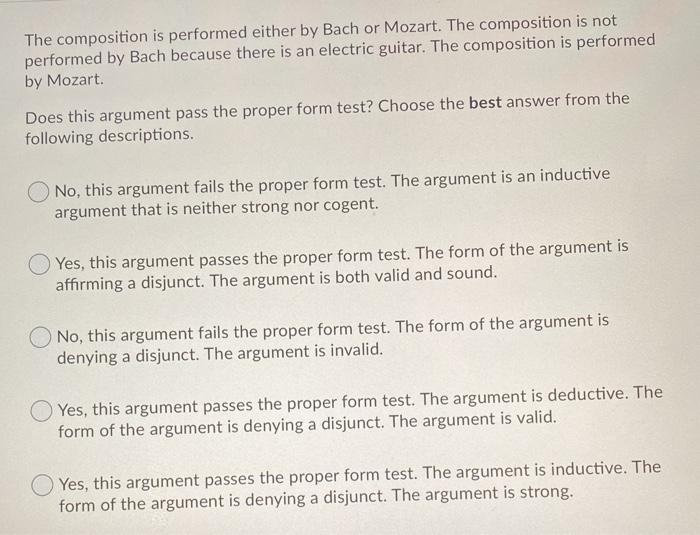
Question: Consider the following argument: The composition is performed either by Bach or Mozart. The composition is not performed by Bach because there is an electric
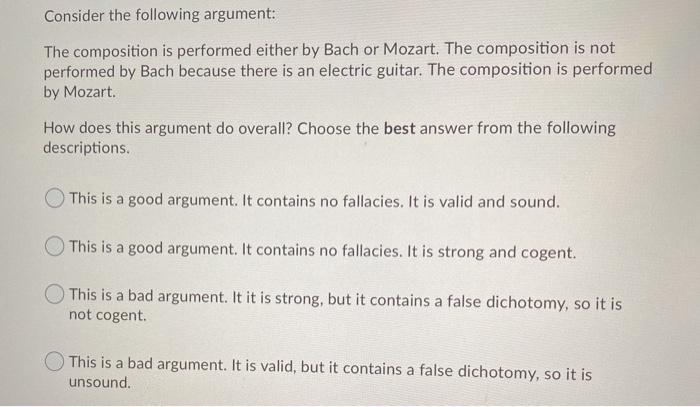
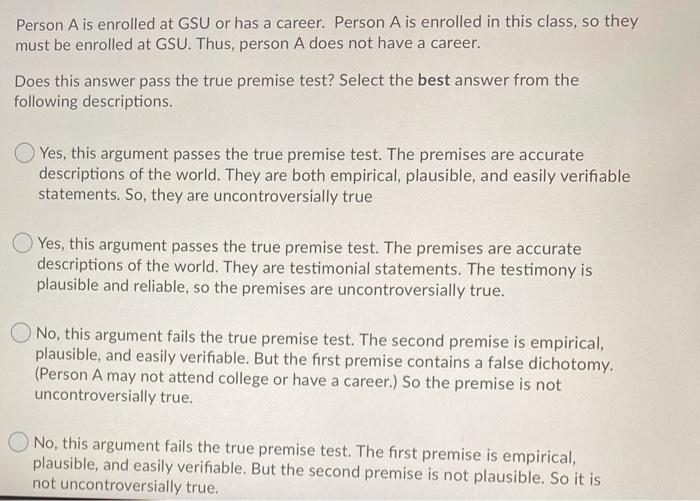
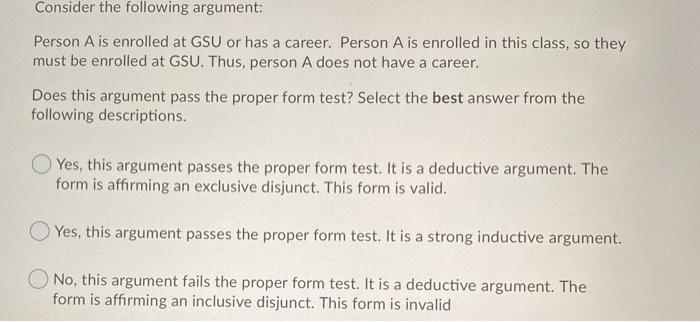
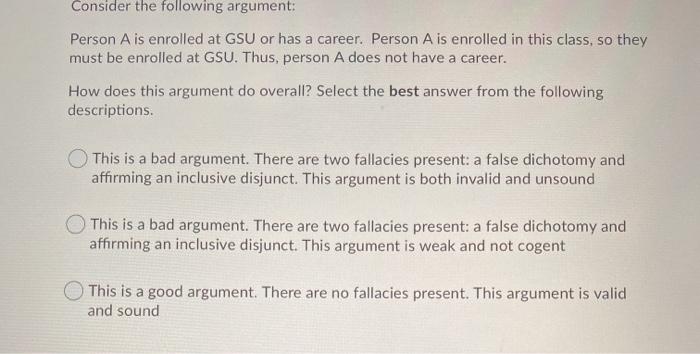
Consider the following argument: The composition is performed either by Bach or Mozart. The composition is not performed by Bach because there is an electric guitar. The composition is performed by Mozart How does this argument do overall? Choose the best answer from the following descriptions This is a good argument. It contains no fallacies. It is valid and sound. This is a good argument. It contains no fallacies. It is strong and cogent. This is a bad argument. It it is strong, but it contains a false dichotomy, so it is not cogent. This is a bad argument. It is valid, but it contains a false dichotomy, so it is unsound. Person A is enrolled at GSU or has a career. Person A is enrolled in this class, so they must be enrolled at GSU. Thus, person A does not have a career. Does this answer pass the true premise test? Select the best answer from the following descriptions. Yes, this argument passes the true premise test. The premises are accurate descriptions of the world. They are both empirical, plausible, and easily verifiable statements. So, they are uncontroversially true Yes, this argument passes the true premise test. The premises are accurate descriptions of the world. They are testimonial statements. The testimony is plausible and reliable, so the premises are uncontroversially true. No, this argument fails the true premise test. The second premise is empirical, plausible, and easily verifiable. But the first premise contains a false dichotomy. (Person A may not attend college or have a career.) So the premise is not uncontroversially true. No, this argument fails the true premise test. The first premise is empirical, plausible, and easily verifiable. But the second premise is not plausible. So it is not uncontroversially true. Consider the following argument: Person A is enrolled at GSU or has a career. Person A is enrolled in this class, so they must be enrolled at GSU. Thus, person A does not have a career. Does this argument pass the proper form test? Select the best answer from the following descriptions Yes, this argument passes the proper form test. It is a deductive argument. The form is affirming an exclusive disjunct. This form is valid. Yes, this argument passes the proper form test. It is a strong inductive argument. No, this argument fails the proper form test. It is a deductive argument. The form is affirming an inclusive disjunct. This form is invalid Consider the following argument: Person A is enrolled at GSU or has a career. Person A is enrolled in this class, so they must be enrolled at GSU. Thus, person A does not have a career. How does this argument do overall? Select the best answer from the following descriptions. This is a bad argument. There are two fallacies present: a false dichotomy and affirming an inclusive disjunct. This argument is both invalid and unsound This is a bad argument. There are two fallacies present: a false dichotomy and affirming an inclusive disjunct. This argument is weak and not cogent This is a good argument. There are no fallacies present. This argument is valid and sound The composition is performed either by Bach or Mozart. The composition is not performed by Bach because there is an electric guitar. The composition is performed by Mozart. Does this argument pass the proper form test? Choose the best answer from the following descriptions. No, this argument fails the proper form test. The argument is an inductive argument that is neither strong nor cogent. Yes, this argument passes the proper form test. The form of the argument is affirming a disjunct. The argument is both valid and sound. No, this argument fails the proper form test. The form of the argument is denying a disjunct. The argument is invalid. Yes, this argument passes the proper form test. The argument is deductive. The form of the argument is denying a disjunct. The argument is valid. Yes, this argument passes the proper form test. The argument is inductive. The form of the argument is denying a disjunct. The argument is strong